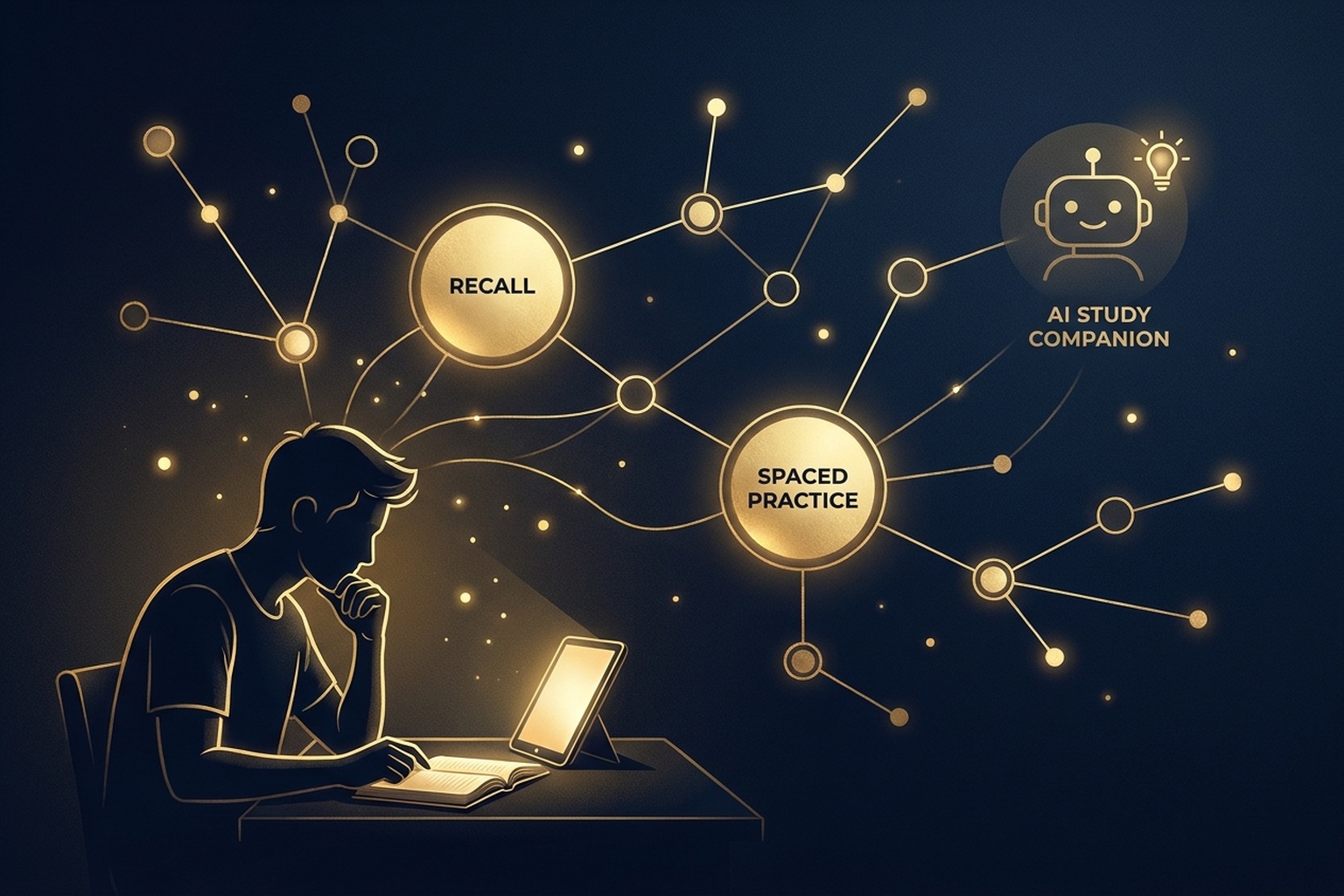
Students have never had more ways to get an answer quickly. A phone can summarize a chapter, an AI tutor can explain a formula, and a search engine can produce a polished outline in seconds. But speed is not the same as learning. The more important question is whether a learner can retrieve an idea later, explain it in their own words, and use it in a situation they have not seen before. Recent education research points toward a practical answer: technology can help, but the learning design matters more than the novelty of the tool.
The strongest study habits are not glamorous. Learners benefit from trying to remember before checking notes, revisiting material after time has passed, and mixing related problem types so they must decide which method fits. Generative AI can make these practices easier to personalize, or it can short-circuit them by supplying a finished answer too early. The difference lies in how the student and teacher structure the interaction.
This article brings together foundational cognitive-science findings, a classroom study of an AI tutor, and recent evidence about spaced practice in STEM courses. The central lesson is not “use AI” or “avoid AI.” It is to keep the learner doing the thinking that produces durable knowledge, while using tools to provide timely questions, feedback, and explanations.
What does it mean to learn, rather than just finish?
A completed worksheet is evidence that a task was completed. It is not, by itself, evidence that the learner can perform the underlying skill independently. A student who reads an explanation and nods may feel fluent because the material is familiar in the moment. Later, when the page is closed, that same student may struggle to recall the key idea. Learning is better tested by what a person can bring to mind and apply after the immediate cues have disappeared.
This distinction helps explain why active recall is so useful. In retrieval practice, a learner attempts to produce an answer from memory before looking it up. The attempt itself can reveal gaps, strengthen access to the knowledge, and help a student see what remains uncertain. Retrieval is not limited to formal quizzes. It can mean explaining yesterday’s lesson from memory, sketching a process without notes, or writing down everything remembered about a topic before reopening the textbook.
In a landmark experiment, Jeffrey Karpicke and Janell Blunt compared retrieval practice with elaborative studying using concept maps. On a delayed test, performance averaged 0.67 in the retrieval-practice condition and 0.45 in the concept-mapping condition, a difference the researchers described as roughly 50 percent better long-term retention. The reported effect was large in that experiment (d = 1.50), but this is not a promise that every student or subject will see the same gain. The important takeaway is that actively retrieving ideas can outperform another careful round of studying, even when the alternative looks intellectually rich. Karpicke and Blunt, Science, 2011.
Retrieval should be low-stakes and followed by feedback. If a learner repeatedly practices an incorrect answer without correction, practice can reinforce confusion. A useful cycle is: try to recall, check the answer, correct the error, then try again later. Teachers can make this feel supportive by treating mistakes as information about what to revisit rather than as a verdict on ability.
Why are spacing and retrieval stronger together?
Spacing means spreading practice across separate sessions instead of concentrating all of it into one long block. Retrieval means attempting to recall or use the knowledge. Combined, they create repeated opportunities to bring an idea back after some forgetting has begun. The effort of reconstructing knowledge can make the next retrieval more durable, while the spacing helps learners revisit it over days rather than relying on short-lived familiarity.
A 2024 meta-analysis of spaced retrieval across nine introductory STEM courses found a small pooled improvement of 2.06 percentage points, with a 95 percent confidence interval from 0.16 to 3.97 points. The result was not uniform: statistically significant positive effects appeared in only two courses, and the authors cautioned that generalization across STEM contexts remains uncertain. That is a valuable finding, not a failure. It tells educators to build schedules that can work in their own courses and measure the results, rather than assuming one interval or routine will fit every learner. The study in the International Journal of STEM Education.
Spacing is not a rigid formula. The right interval depends on how soon the knowledge will be needed, how difficult it is, and how well the learner can currently retrieve it. If a student can recall a concept easily, the next review can be farther away. If they cannot explain it yet, a shorter return with a hint or worked example may be appropriate. The point is to revisit learning over time and use performance to guide the next step.
Interleaving can complement spacing. Instead of completing many nearly identical exercises in a row, learners alternate among related problem types. This makes practice less predictable: students must identify what kind of problem they face before choosing a solution. It can feel slower than blocked practice, where the method is obvious from the previous example, but that extra decision is often precisely what an exam or real-world task demands.
A practical weekly routine might include these steps:
- After a lesson, close the materials and write or draw the main ideas from memory.
- Check the notes, correct errors in a different color, and identify one unresolved question.
- Return the next day for a brief, no-notes quiz or explanation.
- Several days later, mix those questions with material from earlier lessons.
- Before an assessment, use practice problems to diagnose gaps, then review only what the attempts show is weak.
This plan does not need an expensive platform. A paper notebook, teacher-made question bank, flash cards, or a simple mind map can support the same sequence. Digital tools matter when they make it easier to select questions, schedule review, or provide feedback without removing the learner’s role.
Can an AI tutor improve learning without doing the thinking?
AI tutors offer some genuine advantages: they can respond at any hour, rephrase a concept, generate additional examples, and adapt practice to a learner’s current question. Yet a system that instantly supplies complete solutions can turn a learning session into answer collection. The critical design choice is whether the tool first invites the student to reason, predict, explain, or retrieve, and only then provides support calibrated to the learner’s attempt.
A randomized study by Greg Kestin, Kelly Miller, and colleagues examined a research-based AI tutor in an undergraduate physics setting. The study included 194 eligible students and compared AI-supported tutoring with in-class active learning. The authors reported stronger post-test learning in the AI-tutor condition during the study’s instructional unit. This is encouraging evidence that AI can support meaningful learning when deliberately designed around pedagogy. It is not proof that every chatbot, subject, or deployment will produce the same result: the setting, tutor design, lesson, comparison, and duration all matter. Kestin et al., Scientific Reports, 2025.
Newer evidence also cautions against using access to AI as a substitute for a coherent course. A randomized university trial involving 2,379 undergraduates across 30 instructors reported a mixed pattern: students with the course-integrated AI tutor performed better on immediate measures but had lower final grades and less participation in learning-management-system activities. The working paper reports an immediate test-score increase of 7.2 percentage points and a one-week retention increase of 3.9 points, alongside a 0.37-standard-deviation decrease in final grades and a 0.90-standard-deviation decrease in LMS participation. These results are not a universal verdict on AI tutors; they are a reminder that short-term assistance and sustained course engagement are different outcomes. Stanford SCALE summary and IZA Discussion Paper 18989.
Together, these studies make a stronger case for instructional guardrails than for simple adoption metrics. Counting logins or chatbot questions does not show whether students are building independent skill. Educators should ask what students can do without the tool, whether their explanations improve, whether they retain material later, and whether they stay engaged in the broader course. A tutor that makes the next task easier but the learner less capable is not achieving the core educational goal.
How should students use AI as a study coach?
Students can keep AI on the learning-support side of the line by asking for questions, hints, and feedback rather than finished work. The student should make an initial attempt first. That attempt gives the tool something concrete to respond to and gives the learner an opportunity to notice their own reasoning.
Try prompts such as these:
- “Quiz me on this topic one question at a time. Wait for my answer before explaining.”
- “Give me a hint that helps me take the next step, but do not solve the problem for me.”
- “Here is my explanation. Identify one accurate point and one gap, then ask me a follow-up question.”
- “Mix questions from these three topics so I have to decide which principle applies.”
- “After I answer, tell me what evidence in my response supports the conclusion, and what I should check.”
For factual or high-stakes topics, students should verify AI explanations against course materials and trusted references. Generative systems can present errors confidently, omit assumptions, or invent sources. A useful habit is to ask the tool to show the reasoning in small steps, then check the key claim against a textbook, instructor-provided source, or primary research article. AI can help formulate a question; it should not be treated as the final authority.
Teachers can reinforce good habits by designing assignments where students show their thinking: a first attempt, a revision, and a short reflection on what changed. They can explicitly allow some AI uses while naming boundaries for others. Rather than relying only on detection or blanket bans, instructors can make the learning process visible and assess the knowledge students can explain independently.
A simple design checklist for educators
When introducing a digital tutor or study platform, consider whether the learning sequence does the following:
- Begins with a genuine learner attempt before revealing a full solution.
- Uses hints that are gradual and responsive rather than immediately completing the task.
- Schedules retrieval across multiple days and returns to older material.
- Mixes problem types once learners have the basic procedures.
- Provides accurate feedback and lets learners correct mistakes.
- Measures delayed retention, transfer, and independent performance, not only time-on-platform.
- Protects privacy and explains what student data is collected and how it is used.
Educators should also make room for subject-specific differences. Spaced practice results in introductory STEM are promising but not identical across courses. Reading comprehension, laboratory work, language learning, and mathematical problem solving may require different combinations of explanation, practice, collaboration, and feedback. A small classroom pilot with a clear learning objective can reveal whether a particular tool adds value before it becomes a default for every class.
For families and students, the same principle can guide everyday choices: use technology to create more opportunities to think, not fewer. A tool can generate a quiz from notes, ask a learner to compare two explanations, or help plan spaced review. The student still needs to retrieve the ideas, explain why an answer makes sense, and notice when the system is wrong.
The emerging picture is balanced. Learning science does not require schools to reject new technology, and the existence of a polished AI tutor does not guarantee learning. Good instruction puts effort, feedback, and time in the right places. The most promising educational tools are not answer machines; they are practice partners that help learners attempt, reflect, correct, and return to important ideas.
Key Takeaways
- Learning should be judged by retrieval, explanation, retention, and transfer, not by how quickly a task is finished.
- Karpicke and Blunt’s 2011 experiment found better delayed retention after retrieval practice than concept mapping in that study; the result illustrates the value of active recall, not a guaranteed universal percentage gain.
- A nine-course STEM meta-analysis found a small average benefit from spaced retrieval, with meaningful variation by course.
- AI tutoring results depend on design. A 2025 physics RCT was promising, while a larger university trial reported mixed short- and longer-term outcomes.
- Students should attempt first, ask for hints or quizzes, verify important explanations, and revisit material over time.
- Teachers should measure independent learning and delayed outcomes, and preserve student agency, engagement, privacy, and subject-specific judgment.