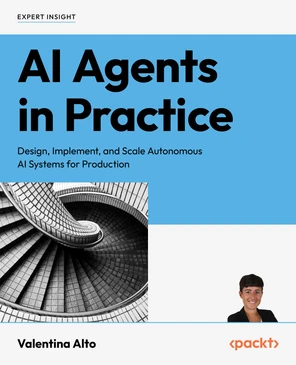
AI agents are moving from clever demonstrations toward systems that plan, call tools, and check work across longer tasks. Google’s November 10 release of Gemini 4 Carbon, paired with a preview of coordinated agents in its Antigravity development environment, puts a practical question in front of builders: as work gets delegated across more steps and more agents, who remains responsible for the final result? A useful starting point is AI Agents in Practice by Valentina Alto, a hands-on book about orchestration, memory, tools, and human oversight.
The news is not that a model has become an independent employee. It is that model makers are packaging increasingly capable reasoning inside workflows where software can delegate subtasks, use tools, and check intermediate outputs. Those are valuable capabilities, but they also make system design matter more. A strong model can still be embedded in a poorly bounded workflow. A team that treats capability as a substitute for controls is confusing a better engine with a safe vehicle.
Google said Gemini 4 Carbon became available to paying developers and enterprises through its API and Gemini for business, with a rollout to Google AI Ultra subscribers in selected consumer products. The company also said it was previewing a “swarm” function in Antigravity, where one prompt can coordinate multiple agents. The Verge’s same-day coverage reported the public rollout and described the feature as a coordinated agent team. These are launch facts and product descriptions, not independent proof that every advertised workflow will work reliably in production. Google’s November 10 announcement and The Verge’s launch report provide the specific source pages.
What changes when a model becomes part of a team of agents?
A single chatbot interaction usually has a clear boundary: a person asks a question, a model returns an answer, and the person decides what to do next. Agent workflows blur that boundary. The system may break a goal into subtasks, retrieve information, call software tools, pass intermediate work between agents, and revise its output. Each step can be useful, but every handoff adds a place where context may be lost, assumptions may be carried forward, or a tool may act on an incorrect interpretation.
It helps to separate three ideas that are often blended together. A model generates or evaluates content. An agent wraps a model in a loop that can select actions and use tools. A multi-agent workflow coordinates several such loops around a larger objective. A swarm can increase parallelism, but parallel work does not automatically mean independent verification: several agents can share the same faulty premise, draw from the same incomplete context, or optimize for the same mistaken goal.
Google positions Carbon for difficult, extended work such as complex coding and scientific reasoning, and says Antigravity’s preview can coordinate agents under one prompt. Google’s page also describes its own benchmark results and demonstrations. Those are useful signals about intended use, but the figures and examples are vendor-reported; a careful buyer should not treat a launch page as a neutral production audit. A benchmark measures selected tasks under defined conditions. It does not by itself answer whether a workflow respects a company’s permissions, handles unusual inputs, or recovers safely when a tool fails.
This is why a team should evaluate the complete workflow rather than model output alone. The relevant question is not merely “Did it produce a good answer?” Ask what information it accessed, which tools it invoked, whether it changed anything, how it verified results, and what a person could inspect before consequential action. For low-risk tasks, a short review may be enough. For actions involving money, customer records, legal commitments, security controls, or public communications, the bar should be much higher.
What can AI Agents in Practice teach about building these workflows?
Valentina Alto’s AI Agents in Practice is published by Packt and is listed by O’Reilly as an August 2025, 282-page book with ISBN 9781805801351. Its contents and publisher description cover the rise of agents, orchestration, memory and context management, external tools and integrations, building an agent with LangChain, and responsible development that includes monitoring and human oversight. That scope makes it a relevant practical companion to this week’s product news: it focuses not just on what a model can say, but on the components that let a system do work. The O’Reilly book page identifies the title, author, publisher, ISBN, and listed topics.
The book’s subject matter suggests a useful way to think about an agent: as a small operational system with a job description, a memory policy, a toolbox, and a supervisor. Those pieces need to fit together. If an agent is allowed to retrieve information but not to update records, that boundary should be explicit. If it can write files or send messages, those actions should be limited to approved destinations and should leave a trace. If a second agent checks the first, the reviewer should have a different task and a clear standard, rather than merely echoing the same answer in a different voice.
Orchestration is the traffic plan. It decides which subtasks run, what data moves between them, and how the workflow resolves disagreements. Memory and context management determine what the system carries forward and what should be discarded. Tool integrations connect a model to the world outside the conversation. Each component can improve usefulness, but each creates a corresponding control question: who may call it, with which permissions, under what limits, and with what record of the action?
Human oversight is not a box to tick after deployment. It is a design choice about where judgment enters the workflow. A reviewer needs enough context to assess an action, not merely a polished summary produced by the same system. For example, a human approving a draft purchase order should see the source request, the extracted fields, any discrepancies, and the exact operation waiting for approval. A reviewer who only sees “Looks good” cannot meaningfully supervise the system.
- Bound the role: define the task, permitted sources, permitted tools, and actions that require a person’s approval.
- Make evidence inspectable: retain links, retrieved passages, intermediate results, and reasons for important decisions.
- Separate suggestion from execution: let the system prepare an action, then require explicit approval before consequential changes.
- Test the handoffs: check what happens when a tool times out, information conflicts, context is missing, or an agent returns an unsupported conclusion.
- Keep a usable audit trail: record which agent did what, under whose permissions, and how the final result was accepted or corrected.
What does the evidence say about adoption and capability?
Stanford HAI’s 2025 AI Index Report gives useful context for the pressure to deploy. It reports that 78% of organizations surveyed said they used AI in 2024, compared with 55% in 2023. The report also says scores on the SWE-bench benchmark rose by 67.3 percentage points between 2023 and 2024. These are findings summarized in the report, not guarantees about any particular vendor’s agent or any particular organization’s results.
The same Stanford HAI report says inference cost for a system performing at GPT-3.5 level fell by more than 280-fold from November 2022 to October 2024, and that nearly 90% of notable AI models in 2024 came from industry, compared with 60% in 2023. Together, the statistics describe a fast-moving environment: more organizations are adopting AI, capability on selected benchmarks has risen, costs have fallen, and commercial developers are central to model production. The numbers do not prove that autonomous workflows are safe or that a model’s benchmark score predicts the quality of a real company process. They explain why organizations are eager to experiment, and why governance must scale with the experiment.
For agent teams, performance is only one dimension. Reliability asks whether the process reaches the right result repeatedly. Traceability asks whether a person can reconstruct why it did so. Security asks whether the system can be tricked into crossing a boundary. Recoverability asks whether a mistake can be detected and reversed. These are separate questions, and the answer may differ for each task. A workflow that summarizes internal documents may be acceptable with sampled review; one that changes account access should have narrow permissions, explicit authorization, and a human-controlled rollback.
How should a team pilot an agent swarm?
A sensible pilot starts with a bounded, repeatable task where a human can independently check the output. Before inviting multiple agents into a process, define success in observable terms and record a baseline. If the existing process takes a person twelve minutes and the agent appears to save time, measure the total review and correction time too. A faster first draft is not a productivity gain if the verification burden doubles or errors are harder to find.
Next, keep the first version read-only wherever possible. Let the system gather and organize information, but do not grant permission to send, purchase, publish, delete, or change access. When read-only results are consistently useful, introduce one narrowly scoped action at a time, with a human approval gate. This staged progression makes it easier to identify which permission or integration caused trouble and avoids giving a new workflow more authority than it has earned.
Teams should also define what the system must do when it cannot verify an answer. The correct fallback is often to stop, show the uncertainty, and ask for review rather than to fill a gap with a plausible guess. “I cannot verify this field” is a successful safety behavior when the alternative is an ungrounded action. That behavior should be tested explicitly, not assumed from the model’s fluent explanations.
A practical pilot checklist can be organized around four gates:
- Task gate: choose a narrow use case, identify the human owner, and list unacceptable outcomes.
- Evidence gate: require traceable inputs and a way for the reviewer to inspect source material.
- Permission gate: start with least privilege and keep consequential actions behind approval.
- Learning gate: track errors, near misses, time saved after review, and changes needed before expanding scope.
Only after those gates work should a team test whether multiple agents add value. Parallel agents make sense when tasks can be separated and their results can be compared. They are less useful when they duplicate the same search, rely on identical assumptions, or create a pile of outputs that a person must reconcile manually. Coordination has a cost. The goal is not to maximize the number of agents; it is to improve a well-defined outcome while keeping the reasoning and authority understandable.
That is the larger lesson in the launch of Gemini 4 Carbon and in Alto’s practical book: agentic AI is not just a model-selection problem. It is a workflow-design problem. Stronger models and coordinated agents may make more complex work possible, but the organization still needs to decide what may be delegated, what evidence is enough, and which actions require a human decision. The more capable the system becomes, the more important it is to build useful checkpoints rather than relying on confidence alone.
Key Takeaways
- Gemini 4 Carbon’s November 10 release and Antigravity swarm preview signal a push toward longer, coordinated agent workflows; product claims should be read as vendor descriptions, not independent guarantees.
- AI Agents in Practice by Valentina Alto covers practical building blocks including orchestration, context, tools, monitoring, and human oversight.
- Stanford HAI’s 2025 AI Index reports rising organizational AI use, benchmark gains, and lower inference costs, but none of those metrics alone establishes production safety.
- Start pilots with narrow tasks, read-only access, inspectable evidence, least privilege, and explicit human approval for consequential actions.
- Scale only when reliability, traceability, security, and recovery are measured alongside speed.
GO DEEPER
Don't just read about this book — explore it.
Summary Maps turns any book into an interactive AI mind map: click through the ideas, quiz yourself, and actually retain what you read.
Free to try — 1 map per day, no account needed.
Try Summary Maps Free →