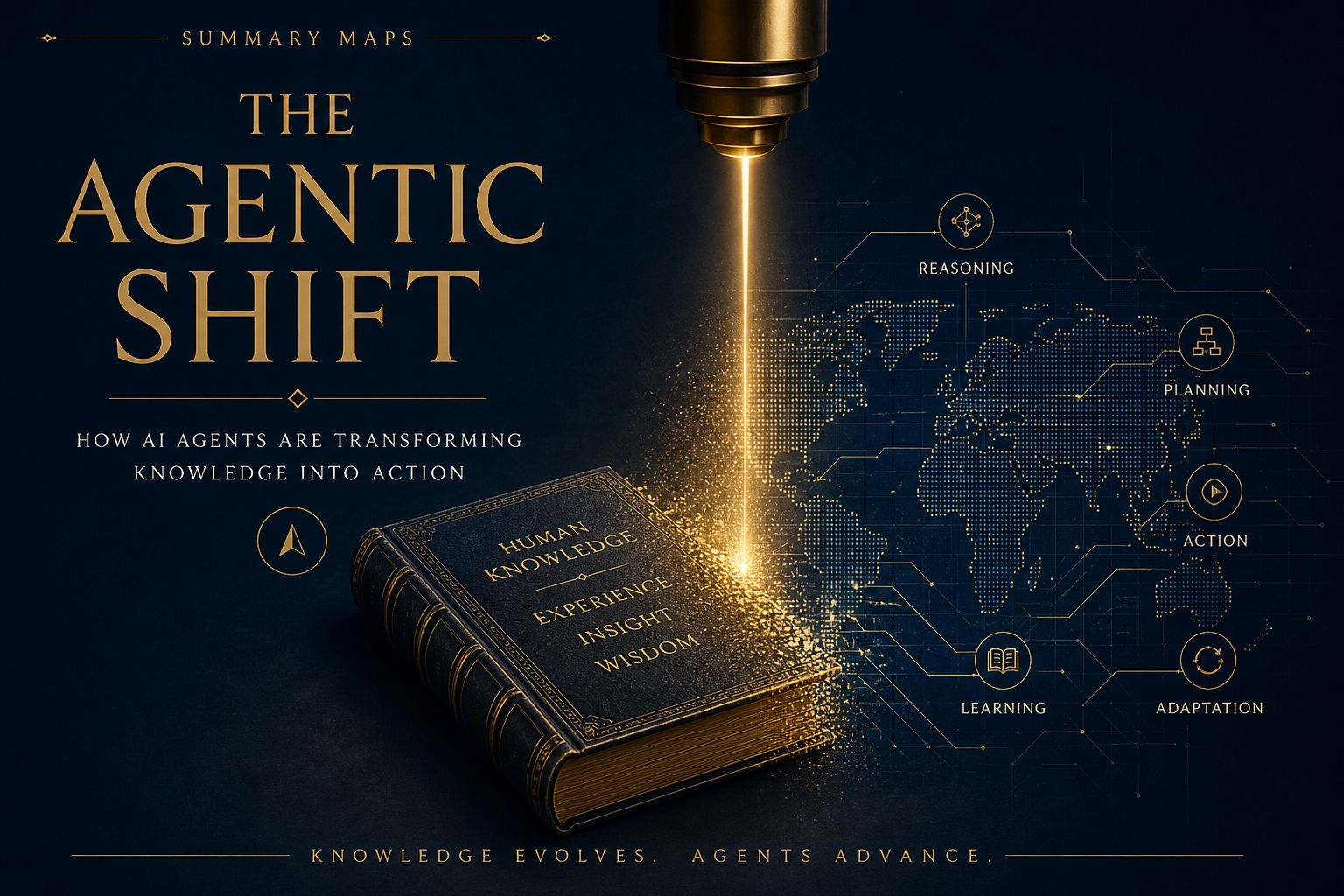
We're living through one of the most disorienting moments in modern professional life. The terrain beneath your feet is shifting faster than most people can track, and the instinct for many is to consume more news, more threads, more hot takes. But here's what the best navigators already know: raw information without structure is just noise. What you need isn't more data. You need a map. And right now, the most powerful map you can carry combines an honest understanding of where Agentic AI is taking us with the deep, durable knowledge that only serious reading can provide.
This is your guide to both.
That era is functionally over.
By mid-2026, the defining characteristic of frontier AI is autonomy. Systems built on GPT-5.6, Claude Mythos 5, and Google's latest Gemini architecture aren't waiting to be asked the same question twice. They're executing multi-step workflows, managing calendars, writing and deploying code, synthesizing research across dozens of sources, and making sequential decisions to complete a goal you set once. You point them toward the horizon. They chart the route and start moving.
This is what the industry means when it says "agentic." An agent doesn't just respond. It acts. It reasons about what step comes next, executes that step, evaluates the result, and adjusts. The difference between a chatbot and an agent is roughly the difference between a compass and a GPS with real-time rerouting. One gives you direction. The other navigates the whole journey.
For professionals and knowledge workers, this distinction carries enormous practical weight. If your current AI usage looks like drafting a single email, summarizing one document, or generating a social caption, you're accessing maybe ten percent of the value available to you. The other ninety percent lives in systems, sequences, and delegation.
Imagine a project manager overseeing a complex construction project. Using agentic AI, they can automate the scheduling of tasks, anticipate supply chain issues based on real-time data, and even automatically generate compliance reports. This level of integration transforms the role from reactive management to proactive oversight, allowing professionals to focus on strategic decisions rather than operational minutiae.
What it means practically is that the barrier to building agentic workflows is no longer primarily financial. A solo professional, a small team, or an independent researcher now has access to tools that, eighteen months ago, were only available to well-funded enterprises. The frontier is democratizing, and with it comes an unprecedented opportunity for innovation and growth.
Consider an independent journalist working on investigative pieces. With open-source AI, they can now analyze vast datasets, cross-reference sources, and even predict trends based on historical data—all without the need for expensive software licenses. This democratization empowers individuals to produce work that was once the domain of large newsrooms, fostering a more diverse and dynamic media landscape.
Books offer a depth and breadth of knowledge that no AI can replicate. They teach us not just facts, but ways of thinking and understanding that are essential in the age of intelligent machines. Whether it's learning the foundational theories of AI in *Superintelligence* by Nick Bostrom or exploring the ethical implications in *Weapons of Math Destruction* by Cathy O'Neil, books are indispensable guides.
We at Summary Maps believe that serious reading is not just about consuming content but about engaging with it critically. This means not just reading to understand, but reading to question, to challenge, and to connect ideas in new ways. Books allow us to build a mental map that complements the physical capabilities offered by AI.
Think of reading as a dialogue with the author. When we read *Thinking, Fast and Slow* by Daniel Kahneman, we're not just absorbing information; we're engaging in a conversation about human cognition that informs how we might design or interact with AI systems.
We believe that the future belongs to those who can navigate this dual landscape intelligently. By combining AI's capabilities with the deep insights offered by serious reading, we can craft a more informed, adaptive approach to personal and professional growth.
Our unique take is that the true power of the agentic frontier lies in its ability to free us from routine tasks, allowing us to focus on critical thinking and innovation. In this way, our bookshelf becomes not just a collection of texts but an evolving map of our intellectual journey.
Moreover, we see the role of books as expanding in this new era. As AI handles more of the mundane, repetitive tasks, we have more time to delve into complex narratives and multifaceted arguments that books offer. This not only enriches our understanding but also enhances our creativity, allowing us to apply learned concepts in innovative ways.
Simultaneously, experiment with open-source AI tools to automate and enhance your workflow. Share your experiences and insights with a community of learners to refine your approach.
Seek out interdisciplinary connections between what you read and your work. If you're a software developer, reading about cognitive science or design thinking can provide fresh insights that inform how you build user interfaces or solve coding challenges.
By deliberately combining the power of Agentic AI with the wisdom embedded in books, you can navigate the complexities of our modern world with confidence and curiosity. Remember, your bookshelf isn't just a collection of books—it's your ultimate map to understanding and thriving in the world of tomorrow.
This is your guide to both.
The Shift from Assistant to Agent: What Actually Changed
For the past several years, most people interacted with AI the way you'd interact with a very fast search engine. You asked a question. It answered. You asked another. It answered again. The model sat still and waited for your next prompt like a reference book that could talk.That era is functionally over.
By mid-2026, the defining characteristic of frontier AI is autonomy. Systems built on GPT-5.6, Claude Mythos 5, and Google's latest Gemini architecture aren't waiting to be asked the same question twice. They're executing multi-step workflows, managing calendars, writing and deploying code, synthesizing research across dozens of sources, and making sequential decisions to complete a goal you set once. You point them toward the horizon. They chart the route and start moving.
This is what the industry means when it says "agentic." An agent doesn't just respond. It acts. It reasons about what step comes next, executes that step, evaluates the result, and adjusts. The difference between a chatbot and an agent is roughly the difference between a compass and a GPS with real-time rerouting. One gives you direction. The other navigates the whole journey.
For professionals and knowledge workers, this distinction carries enormous practical weight. If your current AI usage looks like drafting a single email, summarizing one document, or generating a social caption, you're accessing maybe ten percent of the value available to you. The other ninety percent lives in systems, sequences, and delegation.
Imagine a project manager overseeing a complex construction project. Using agentic AI, they can automate the scheduling of tasks, anticipate supply chain issues based on real-time data, and even automatically generate compliance reports. This level of integration transforms the role from reactive management to proactive oversight, allowing professionals to focus on strategic decisions rather than operational minutiae.
The Open-Source Horizon: Access for Everyone
One of the most significant developments running parallel to the agentic shift is the rapid closing of the performance gap between proprietary frontier models and open-source alternatives. Chinese-developed models including Qwen, DeepSeek, and GLM-5.2 have reached benchmark performance that rivals models costing ten to twenty times more to access. This isn't a minor footnote. It's a fundamental redrawing of the map.What it means practically is that the barrier to building agentic workflows is no longer primarily financial. A solo professional, a small team, or an independent researcher now has access to tools that, eighteen months ago, were only available to well-funded enterprises. The frontier is democratizing, and with it comes an unprecedented opportunity for innovation and growth.
Consider an independent journalist working on investigative pieces. With open-source AI, they can now analyze vast datasets, cross-reference sources, and even predict trends based on historical data—all without the need for expensive software licenses. This democratization empowers individuals to produce work that was once the domain of large newsrooms, fostering a more diverse and dynamic media landscape.
Building Your Knowledge Map: Books as a Compass
As we navigate this agentic frontier, it's crucial to remember that technology isn't the only map at our disposal. Books remain a critical compass for understanding and adapting to the world around us. While Agentic AI provides the tools and routes, books provide the wisdom and context needed to chart meaningful journeys.Books offer a depth and breadth of knowledge that no AI can replicate. They teach us not just facts, but ways of thinking and understanding that are essential in the age of intelligent machines. Whether it's learning the foundational theories of AI in *Superintelligence* by Nick Bostrom or exploring the ethical implications in *Weapons of Math Destruction* by Cathy O'Neil, books are indispensable guides.
We at Summary Maps believe that serious reading is not just about consuming content but about engaging with it critically. This means not just reading to understand, but reading to question, to challenge, and to connect ideas in new ways. Books allow us to build a mental map that complements the physical capabilities offered by AI.
Think of reading as a dialogue with the author. When we read *Thinking, Fast and Slow* by Daniel Kahneman, we're not just absorbing information; we're engaging in a conversation about human cognition that informs how we might design or interact with AI systems.
Practical Applications: Harnessing Agentic AI and Books
To truly benefit from the agentic frontier, we must learn to integrate AI and traditional learning tools effectively. Here are some practical steps you can take:- Set Clear Goals: Use AI to automate routine tasks, but let books guide your strategic thinking. Define your objectives clearly and let both AI and reading inform your path to achieving them. For example, if you're a marketer looking to expand your reach, use AI to analyze consumer data and trends, while books on consumer psychology can provide deeper insights into human behavior.
- Create a Learning System: Develop a habit of continuous learning. Use mind mapping tools to visualize connections between what you read and what you implement with AI. This could involve creating a digital mind map that links concepts from different books to specific AI applications or outcomes.
- Leverage Open-Source Tools: Explore platforms like Hugging Face or GitHub to access cutting-edge AI models that can be tailored to your specific needs. Start with small projects, like using a language model to automate email responses, and gradually build up to more complex applications.
- Engage in Active Reading: Rather than passively consuming books, annotate, highlight, and discuss them. Use AI tools to generate summaries or insights, then critically evaluate these with your own understanding. Join book clubs or online forums to discuss your insights and gain new perspectives.
- Integrate AI and Books in Problem-Solving: When faced with a complex problem, use AI to gather and analyze data, then turn to books to explore different problem-solving strategies. This dual approach can lead to more innovative and effective solutions.
Editorial Opinion: Our Unique Take on Agentic AI and Reading
At Summary Maps, we view the agentic shift not just as a technological evolution, but as an opportunity to refine how we learn and work. The integration of AI and books is not about choosing one over the other but about leveraging both to their fullest potential.We believe that the future belongs to those who can navigate this dual landscape intelligently. By combining AI's capabilities with the deep insights offered by serious reading, we can craft a more informed, adaptive approach to personal and professional growth.
Our unique take is that the true power of the agentic frontier lies in its ability to free us from routine tasks, allowing us to focus on critical thinking and innovation. In this way, our bookshelf becomes not just a collection of texts but an evolving map of our intellectual journey.
Moreover, we see the role of books as expanding in this new era. As AI handles more of the mundane, repetitive tasks, we have more time to delve into complex narratives and multifaceted arguments that books offer. This not only enriches our understanding but also enhances our creativity, allowing us to apply learned concepts in innovative ways.
Conclusion: Actionable Next Steps
As we stand on the precipice of this agentic frontier, the key is not to be overwhelmed by the pace of change but to strategically harness it. Start by setting aside time each week for uninterrupted reading. Choose books that challenge your thinking and expand your understanding of AI and its implications.Simultaneously, experiment with open-source AI tools to automate and enhance your workflow. Share your experiences and insights with a community of learners to refine your approach.
Seek out interdisciplinary connections between what you read and your work. If you're a software developer, reading about cognitive science or design thinking can provide fresh insights that inform how you build user interfaces or solve coding challenges.
By deliberately combining the power of Agentic AI with the wisdom embedded in books, you can navigate the complexities of our modern world with confidence and curiosity. Remember, your bookshelf isn't just a collection of books—it's your ultimate map to understanding and thriving in the world of tomorrow.