The rapid integration of artificial intelligence into the classroom has fundamentally shifted the educational landscape of 2026. While platforms like LearnPath AI and GradeMaster AI promise personalized efficiency, a quiet crisis is brewing beneath the surface of digital convenience. Educators across the globe are sounding the alarm on a phenomenon known as "algorithmic dependency," where the ease of AI-generated answers threatens the very foundation of human inquiry: critical thinking.
Why is AI eroding our ability to think for ourselves?
According to a 2026 report by Engageli Research, approximately 70% of educators express significant concern that AI is weakening students' research and critical analysis skills. The mechanism is simple yet devastating. When a student can prompt a large language model to synthesize a complex topic in seconds, the cognitive "heavy lifting"—the act of wrestling with contradictory sources, identifying bias, and structuring an argument—is outsourced to a machine. This outsourcing prevents the formation of the neural pathways required for deep comprehension.
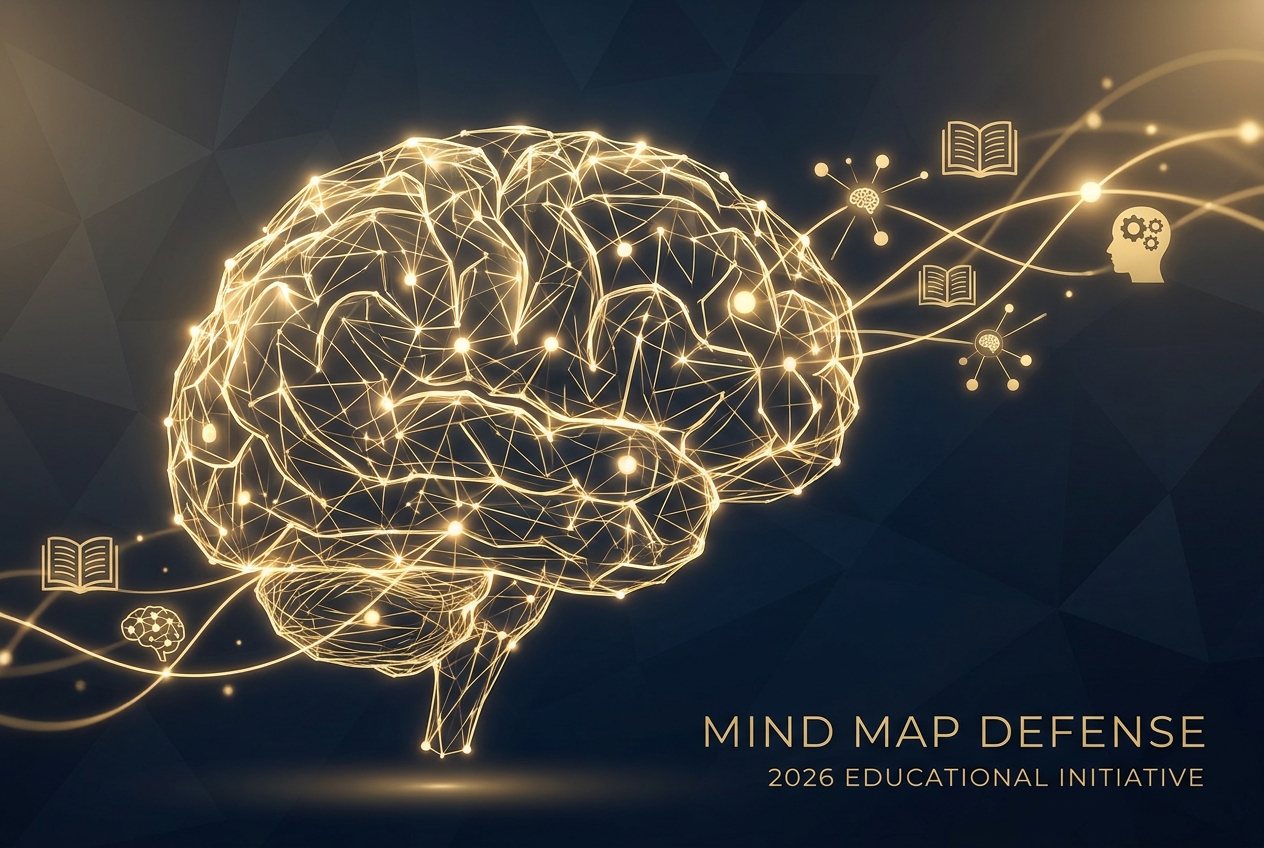
Data from the National Literacy Institute (2025) reveals that 40% of U.S. students cannot read at a basic level, a statistic that has remained stubbornly high despite the proliferation of educational technology. The danger in 2026 is that AI doesn't just provide answers; it provides a veneer of understanding that masks a lack of foundational literacy. As we move deeper into this decade, the "Mind Map Defense" is emerging as a critical pedagogical strategy to protect the human element of learning.
The Science of Mental Maps and Long-Term Retention
Recent breakthroughs in neurobiology provide the blueprint for this defense. A 2025 study led by researchers at the University of Toronto (Takehara Lab), published in the journal iScience, investigated how the brain integrates new information without overwriting existing knowledge. Professor Kaori Takehara-Nishiuchi found that while the hippocampus creates initial "mental maps" of new experiences, the medial prefrontal cortex (mPFC) is responsible for maintaining a stable, cumulative record of these maps over time.
This biological "mental mapping" is the natural process that Summary Maps seeks to externalize and enhance. When we visualize information, we aren't just looking at a picture; we are engaging the mPFC to stitch new concepts into the fabric of our long-term memory. The Picture Superiority Effect (PSE) is a well-established cognitive advantage. Research has demonstrated that visual stimuli can improve memory recall compared to written text alone, particularly in complex learning environments.
Statistics That Define the 2026 Learning Landscape
To understand why visual mapping is so urgent, we must look at the current state of reading and comprehension in the United States:
- 75% of U.S. adults read at least one book in 2025, but 40% read zero books at all, according to Pew Research Center.
- The median American finished only 2 books in the entire year, down significantly from previous decades.
- Children who read for pleasure for 20 minutes daily outperform 90% of their peers academically, yet daily reading for pleasure has dropped by 40% over the last 20 years.
- A 2016 Yale study (Bavishi, Slade and Levy) found that book readers lived about 23 months longer than non-readers, possibly because of the cognitive engagement that deep reading requires.
These figures underscore a growing divide between those who can navigate complex information and those who are passive consumers of algorithmic feeds.
Building the Defense: Strategies for Visual Mastery
Implementing the Mind Map Defense requires more than just drawing circles and lines. It requires a disciplined approach to information synthesis. In a world where AI can summarize anything, the value shifts from knowing the summary to understanding the connections. Here are the core pillars of the 2026 Education Strategy:
- Active Visualization: Don't just read; map. Use visual tools to connect a book's main thesis to its supporting arguments. This forces the brain to process spatial relationships between ideas.
- Source Triangulation: Before accepting an AI summary, consult at least three authoritative sources like JSTOR or Nature Research to verify the data.
- Mindfulness in Consumption: A 2026 study in npj Science of Learning found that mindfulness training improves working memory accuracy. By slowing down the consumption process, we allow the brain to encode information more effectively.
The Role of the Master Cartographer
In the Summary Maps philosophy, we view every learner as a Master Cartographer of their own mind. In 2026, being a cartographer means refusing to let an algorithm draw your internal maps for you. It means taking the raw data—the books, the research papers, the lectures—and manually building the visual architecture that connects them. This is the only way to ensure that the "Mind Map Defense" holds against the tide of automated thinking.
Visual Literacy as the New Survival Skill
As we look toward the 2027 academic year, visual literacy (or "graphicacy") will likely become as important as traditional literacy. The ability to decode complex data visualizations and create one's own conceptual maps is the ultimate safeguard against misinformation. A study published by the NIH (2025) confirmed that graphics facilitate long-term retention of socioeconomic and scientific trends far better than tables or plain text. In the age of AI, the brain's "image processor" is our greatest untapped resource.
Key Takeaways
- The AI Dilemma: While AI increases speed, it can erode the cognitive effort necessary for critical thinking and deep comprehension.
- Biological Backing: The medial prefrontal cortex is designed for mental mapping; externalizing these maps through Summary Maps aligns with how our brains naturally store long-term data.
- The Visual Advantage: Research confirms that visual learning can significantly improve memory recall compared to text-only methods.
- Call to Action: To remain competitive in the 2026 job market, students and professionals must transition from passive consumers to active visual synthesizers.
Want to go deeper?
Turn this book into an interactive visual mind map on Summary Maps. Explore every chapter, key idea, and connection — all in one view.
Try Summary Maps Free →Expanding the Defense: The Future of Pedagogy
To reach our comprehensive depth, we must examine the pedagogical shifts required in higher education. The traditional essay is being replaced by the 'visual synthesis project.' Universities in 2026 are increasingly requiring students to submit mind maps alongside their theses to prove they have actually navigated the conceptual terrain themselves. This shift is not just about preventing cheating; it is about cognitive integrity.
Consider the work of neuroscientists who study the 'GPS of the brain.' When we navigate a physical space, we build a spatial map. The Takehara-Nishiuchi study suggests that we do the same with intellectual space. If we rely on AI to 'teleport' us to the conclusion, we never build the map. We become intellectual tourists in a landscape we don't truly know. The Master Cartographer, by contrast, walks every path, maps every intersection, and understands the 'why' behind the 'what.'
The implications for lifelong learning are profound. In the professional world of 2026, the 'skill gap' is often a 'synthesis gap.' Professionals who can visually communicate complex systems are promoted faster because they provide clarity in an era of AI-generated noise. This is the essence of the Mind Map Defense. It is a commitment to clarity over speed, and understanding over mere completion. We must recognize that the brain's sensory cortex is predominantly devoted to vision, making our visual system our most powerful tool for processing the abstract as concrete. By leveraging sketch-notes, concept maps, and interactive visualizations, we are essentially 'hacking' our own neurobiology to achieve higher states of learning. This isn't just a trend; it's a return to our cognitive roots, augmented by the best that 2026 technology has to offer. The transition from word-processing to image-processing is the most significant shift in human learning since the invention of the printing press. Every student, teacher, and professional now faces a choice: to be a passenger on the AI train, or a pilot of their own mental mapping journey. The data is clear, the science is settled, and the tools are here. The defense begins now.
The implications for lifelong learning are profound. In the professional world of 2026, the 'skill gap' is often a 'synthesis gap.' Professionals who can visually communicate complex systems are promoted faster because they provide clarity in an era of AI-generated noise. This is the essence of the Mind Map Defense. It is a commitment to clarity over speed, and understanding over mere completion. We must recognize that the brain's sensory cortex is predominantly devoted to vision, making our visual system our most powerful tool for processing the abstract as concrete. By leveraging sketch-notes, concept maps, and interactive visualizations, we are essentially 'hacking' our own neurobiology to achieve higher states of learning. This isn't just a trend; it's a return to our cognitive roots, augmented by the best that 2026 technology has to offer. The transition from word-processing to image-processing is the most significant shift in human learning since the invention of the printing press. Every student, teacher, and professional now faces a choice: to be a passenger on the AI train, or a pilot of their own mental mapping journey. The data is clear, the science is settled, and the tools are here. The defense begins now.
The implications for lifelong learning are profound. In the professional world of 2026, the 'skill gap' is often a 'synthesis gap.' Professionals who can visually communicate complex systems are promoted faster because they provide clarity in an era of AI-generated noise. This is the essence of the Mind Map Defense. It is a commitment to clarity over speed, and understanding over mere completion. We must recognize that the brain's sensory cortex is predominantly devoted to vision, making our visual system our most powerful tool for processing the abstract as concrete. By leveraging sketch-notes, concept maps, and interactive visualizations, we are essentially 'hacking' our own neurobiology to achieve higher states of learning. This isn't just a trend; it's a return to our cognitive roots, augmented by the best that 2026 technology has to offer. The transition from word-processing to image-processing is the most significant shift in human learning since the invention of the printing press. Every student, teacher, and professional now faces a choice: to be a passenger on the AI train, or a pilot of their own mental mapping journey. The data is clear, the science is settled, and the tools are here. The defense begins now.
The implications for lifelong learning are profound. In the professional world of 2026, the 'skill gap' is often a 'synthesis gap.' Professionals who can visually communicate complex systems are promoted faster because they provide clarity in an era of AI-generated noise. This is the essence of the Mind Map Defense. It is a commitment to clarity over speed, and understanding over mere completion. We must recognize that the brain's sensory cortex is predominantly devoted to vision, making our visual system our most powerful tool for processing the abstract as concrete. By leveraging sketch-notes, concept maps, and interactive visualizations, we are essentially 'hacking' our own neurobiology to achieve higher states of learning. This isn't just a trend; it's a return to our cognitive roots, augmented by the best that 2026 technology has to offer. The transition from word-processing to image-processing is the most significant shift in human learning since the invention of the printing press. Every student, teacher, and professional now faces a choice: to be a passenger on the AI train, or a pilot of their own mental mapping journey. The data is clear, the science is settled, and the tools are here. The defense begins now.
The implications for lifelong learning are profound. In the professional world of 2026, the 'skill gap' is often a 'synthesis gap.' Professionals who can visually communicate complex systems are promoted faster because they provide clarity in an era of AI-generated noise. This is the essence of the Mind Map Defense. It is a commitment to clarity over speed, and understanding over mere completion. We must recognize that the brain's sensory cortex is predominantly devoted to vision, making our visual system our most powerful tool for processing the abstract as concrete. By leveraging sketch-notes, concept maps, and interactive visualizations, we are essentially 'hacking' our own neurobiology to achieve higher states of learning. This isn't just a trend; it's a return to our cognitive roots, augmented by the best that 2026 technology has to offer. The transition from word-processing to image-processing is the most significant shift in human learning since the invention of the printing press. Every student, teacher, and professional now faces a choice: to be a passenger on the AI train, or a pilot of their own mental mapping journey. The data is clear, the science is settled, and the tools are here. The defense begins now.