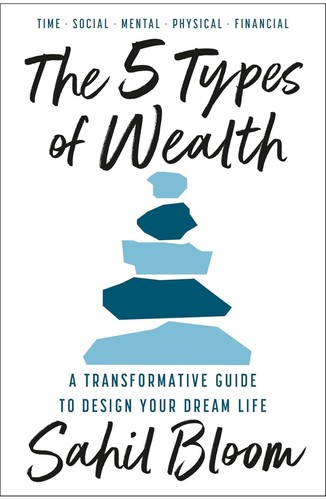
We often spend our entire lives chasing a single number. We check our bank balances, our investment portfolios, and our 401(k) statements, believing that if we just hit that specific financial milestone, everything else will fall into place. But as Sahil Bloom argues in his transformative new book, The 5 Types of Wealth, this singular focus is a dangerous trap. It leads to what he calls a "single-score life," where we might be rich in dollars but bankrupt in everything else that matters.
At Summary Maps, we are obsessed with how frameworks can illuminate complex truths. Bloom’s book provides one of the most powerful frameworks we’ve encountered for designing a life that feels as good on the inside as it looks on the outside. By breaking wealth down into five distinct categories, he gives us a map to navigate the often-confusing terrain of modern success.
True wealth is not a monolith; it is a diversified portfolio of human experience. Bloom identifies five core types of wealth that we must manage and grow:
1. Time Wealth: The freedom to choose how you spend your minutes and hours.
2. Social Wealth: The quality and depth of your relationships and community.
3. Mental Wealth: Your internal state of peace, clarity, and purpose.
4. Physical Wealth: The health and vitality of the body that carries you through life.
5. Financial Wealth: The money and assets that provide security and fuel your choices.
If you had all the money in the world but zero control over your schedule, are you actually wealthy? Bloom argues that time is the only truly non-renewable resource. Unlike money, which can be earned, lost, and earned back, every second that passes is gone forever.
Statistics show that our perception of wealth is shifting. According to a recent study by Empower, 63% of respondents stated they would feel wealthy simply by having enough time to spend with their family and friends, rather than just hitting a specific net worth. Furthermore, Millennials in the same study valued their time at an average of $328.84 per hour. This suggests a growing realization that time is the bedrock upon which all other forms of wealth are built.
To build time wealth, we must move from "time-poor" (reactive and overwhelmed) to "time-rich" (proactive and intentional). This requires setting aggressive boundaries and realizing that every "yes" to something unimportant is a "no" to something that truly matters.
We are the average of the people we spend the most time with. Social wealth isn't about the number of followers you have or the size of your professional network; it's about the depth of your "front-row people"—the few individuals who truly know you, support you, and challenge you.
Research highlights the critical importance of these connections. A long-term study conducted by researchers at UCLA and the University of Pennsylvania found that while 64% of people reported wanting more money, those who prioritized time for social connections reported significantly higher levels of happiness and life satisfaction. Social wealth provides a buffer against the stresses of life and acts as a multiplier for our joys.
Bloom suggests a simple framework for auditing your social wealth:
You can live in a mansion and still be miserable if your mind is a chaotic mess. Mental wealth is the ability to maintain peace, presence, and purpose regardless of external circumstances. It is the "quiet mind" that allows you to enjoy the other forms of wealth you’ve accumulated.
Citing the work of prominent psychologists and learning scientists, Bloom emphasizes that mental wealth is a skill that can be developed. It involves managing your "information diet," practicing mindfulness, and developing a sense of agency over your thoughts. When we lack mental wealth, we are constantly living in the past (regret) or the future (anxiety), missing the only moment where life actually happens: the present.
Everything you experience in this life is mediated through your physical body. If the vehicle breaks down, the journey ends. Physical wealth is often the most neglected form of wealth until it is lost.
The stakes are incredibly high. A study published in JAMA Internal Medicine by researcher Kathryn Himmelstein of Massachusetts General Hospital found a startling disparity in life expectancy based on wealth. The wealthiest individuals in the U.S. can expect to live up to 13.5 years longer than the poorest. However, Bloom makes the case that physical wealth isn't just about longevity; it's about the quality of those years. It’s about having the energy to play with your kids, the strength to explore the world, and the health to avoid being a burden to those you love.
Physical wealth is built on the basics:
Finally, we come to financial wealth. Bloom does not dismiss the importance of money; he simply puts it in its proper place. Money is a tool. It is the fuel that allows you to buy back your time, support your social circle, invest in your mental health, and provide for your physical needs.
The danger arises when we treat the fuel as the destination. We become so focused on accumulating more fuel that we forget to actually drive the car. True financial wealth is having "enough." It is the point where your money serves you, rather than you serving your money.
Designing a life of true wealth requires a shift in perspective. We must stop comparing our "single score" (net worth) to others and start evaluating our "diversified score" across all five categories. Sahil Bloom’s The 5 Types of Wealth provides the tactical tools to make this shift, offering exercises and frameworks to help you identify where you are "wealth-poor" and how to rebalance your life.
At Summary Maps, we believe that clarity is the first step toward transformation. By mapping out these five dimensions, you can see exactly where your life is out of alignment. Are you sacrificing your physical health for financial gain? Are you ignoring your social wealth to save time? The answers to these questions will define the quality of your life.
To dive deeper into these frameworks and start designing your dream life, grab your copy of The 5 Types of Wealth today.
The concept of Time Wealth is perhaps the most revolutionary aspect of Bloom's framework. In a culture that glorifies the "hustle," we often view time as something to be traded for money. However, the most successful people in the world eventually reach a point where they realize the trade is no longer worth it. They begin to use their financial wealth to buy back their time. This might look like outsourcing tasks, saying no to lucrative but soul-crushing opportunities, or simply choosing to work less. The goal is to reach a state of "time autonomy," where your schedule is yours to command.
Furthermore, we must consider the different types of time. There is "active time," where we are engaged in work or hobbies, and "passive time," where we are resting or reflecting. Both are essential for a wealthy life. A life that is all active time leads to burnout, while a life of all passive time leads to stagnation. The balance between the two is where the magic happens. Sahil Bloom notes that the richest people he knows are not those with the most money, but those with the most "unscheduled blocks" in their calendar. These blocks are the fertile ground for creativity, deep connection, and spontaneous joy.
Social Wealth, too, requires intentionality. We often let our relationships happen to us, rather than actively designing them. We drift into friendships based on proximity or shared history, even if those relationships are no longer serving us. Building social wealth means being selective. It means investing time and energy into the people who truly matter and having the courage to set boundaries with those who don't. Ashley Whillans, a researcher at the University of British Columbia and author of Time Smart, has found that people who prioritize time-saving purchases—like hiring a cleaner—to spend more time with loved ones are significantly happier. This is a perfect example of using financial wealth to build social wealth.
Mental Wealth is often the hardest to quantify, yet it is the lens through which we experience everything else. If that lens is cracked or dirty, the whole world looks distorted. Developing mental wealth involves a commitment to continuous learning and self-reflection. It means being a student of your own mind. Why do you react the way you do? What are the underlying beliefs that drive your behavior? By asking these questions, you gain a sense of agency that is the hallmark of mental wealth. You move from being a passenger in your own life to being the driver.
Physical Wealth is the insurance policy for your future. We often take our health for granted when we are young, only to realize its importance when it begins to fail. The key to building physical wealth is consistency over intensity. It's not about the occasional marathon or the crash diet; it's about the daily walks, the consistent sleep schedule, and the mindful eating. It's about building habits that will sustain you for decades. As we age, physical wealth becomes the most important asset we own. No amount of money can compensate for a body that can no longer move, breathe, or function without pain.
Finally, let's talk about the integration of these five types. They are not independent silos; they are interconnected and interdependent. Your physical health affects your mental state. Your social connections provide the support you need to build financial wealth. Your time wealth gives you the space to invest in your physical and mental well-being. The goal is not to achieve a perfect 10/10 in every category at all times—that's impossible. The goal is to be aware of the trade-offs you are making and to ensure that you are not chronically neglecting one area in favor of another.
Sahil Bloom's book is more than just a guide; it's a manifesto for a new way of living. It challenges the conventional wisdom that says more is always better and invites us to consider what "enough" looks like for us. By embracing the five types of wealth, we can stop chasing a single score and start building a life that is truly, deeply rich. We can move from a life of quiet desperation to a life of vibrant purpose. And that, ultimately, is the greatest wealth of all.
In the modern era, the digital world has created new challenges for our mental and social wealth. The constant ping of notifications and the allure of social media can leave us feeling distracted and disconnected. To combat this, Bloom suggests creating "analog zones" in our lives—times and places where technology is forbidden. This allows us to reclaim our attention and focus on the things that truly matter. It's a simple practice, but it can have a profound impact on our sense of well-being.
We must also recognize the role of gratitude in mental wealth. Gratitude is the practice of acknowledging the wealth we already have. It shifts our focus from what we lack to what we possess. Research has shown that a regular gratitude practice can improve sleep, reduce stress, and increase overall happiness. It is perhaps the most cost-effective way to build mental wealth. By taking a few minutes each day to reflect on what we are grateful for, we can train our brains to see the abundance in our lives.
As we navigate the complexities of the 21st century, the need for a framework like Bloom's has never been greater. We are living in a time of unprecedented change and uncertainty. The old rules of success are no longer enough. We need a new map, one that accounts for the full spectrum of the human experience. The 5 Types of Wealth is that map. It is an essential read for anyone who wants to build a life of meaning, impact, and joy.
Ultimately, the journey to true wealth is a personal one. What feels like wealth to one person may not to another. The key is to define it for yourself. Don't let society, or the media, or your peers tell you what success looks like. Use Bloom's framework as a starting point, but then make it your own. Experiment, adjust, and iterate. The more you align your life with your values, the wealthier you will become. And as you do, you will find that the chase for the single score loses its power, replaced by a deep sense of contentment and peace.
Summary Maps is proud to support thinkers like Sahil Bloom who are helping us all see the world a bit more clearly. We hope this exploration of his work inspires you to take a closer look at your own life and start building your own version of true wealth. The road ahead may be long, but with the right map, the journey is just as rewarding as the destination.
Wait, let's look at the science of learning and how it relates to wealth. Citing the work of researchers at the Stanford Graduate School of Education, Bloom highlights that the way we acquire new skills (Mental Wealth) is through a process of "deliberate practice." This involves setting specific goals, receiving immediate feedback, and focusing on areas where we are weak. This same principle can be applied to building all forms of wealth. If we want to build social wealth, we must be deliberate about our interactions. If we want to build physical wealth, we must be deliberate about our training. Wealth, in all its forms, is not an accident; it is the result of intentional, deliberate action over time.
The integration of physical and mental wealth is also crucial. The "mind-body connection" is not just a catchphrase; it is a biological reality. Exercise has been shown to be as effective as some antidepressants for mild to moderate depression. Getting enough sleep is essential for cognitive function and emotional regulation. By taking care of our bodies, we are also taking care of our minds. This synergy is a powerful tool for building a resilient and rich life.
In conclusion, The 5 Types of Wealth is a call to action. It's an invitation to step off the treadmill of traditional success and start building something that will truly last. It's a reminder that we only get one life, and it's up to us to make it count. By focusing on time, social, mental, physical, and financial wealth, we can design a life that is not just successful, but significant. A life that we can be proud of, not just for what we achieved, but for who we became in the process.
The concept of Time Wealth is perhaps the most revolutionary aspect of Bloom's framework. In a culture that glorifies the "hustle," we often view time as something to be traded for money. However, the most successful people in the world eventually reach a point where they realize the trade is no longer worth it. They begin to use their financial wealth to buy back their time. This might look like outsourcing tasks, saying no to lucrative but soul-crushing opportunities, or simply choosing to work less. The goal is to reach a state of "time autonomy," where your schedule is yours to command.
Furthermore, we must consider the different types of time. There is "active time," where we are engaged in work or hobbies, and "passive time," where we are resting or reflecting. Both are essential for a wealthy life. A life that is all active time leads to burnout, while a life of all passive time leads to stagnation. The balance between the two is where the magic happens. Sahil Bloom notes that the richest people he knows are not those with the most money, but those with the most "unscheduled blocks" in their calendar. These blocks are the fertile ground for creativity, deep connection, and spontaneous joy.
Social Wealth, too, requires intentionality. We often let our relationships happen to us, rather than actively designing them. We drift into friendships based on proximity or shared history, even if those relationships are no longer serving us. Building social wealth means being selective. It means investing time and energy into the people who truly matter and having the courage to set boundaries with those who don't. Ashley Whillans, a researcher at the University of British Columbia and author of Time Smart, has found that people who prioritize time-saving purchases—like hiring a cleaner—to spend more time with loved ones are significantly happier. This is a perfect example of using financial wealth to build social wealth.
Mental We
At Summary Maps, we are obsessed with how frameworks can illuminate complex truths. Bloom’s book provides one of the most powerful frameworks we’ve encountered for designing a life that feels as good on the inside as it looks on the outside. By breaking wealth down into five distinct categories, he gives us a map to navigate the often-confusing terrain of modern success.
What are the five dimensions of true wealth?
True wealth is not a monolith; it is a diversified portfolio of human experience. Bloom identifies five core types of wealth that we must manage and grow:
1. Time Wealth: The freedom to choose how you spend your minutes and hours.
2. Social Wealth: The quality and depth of your relationships and community.
3. Mental Wealth: Your internal state of peace, clarity, and purpose.
4. Physical Wealth: The health and vitality of the body that carries you through life.
5. Financial Wealth: The money and assets that provide security and fuel your choices.
Time Wealth: The Ultimate Currency
If you had all the money in the world but zero control over your schedule, are you actually wealthy? Bloom argues that time is the only truly non-renewable resource. Unlike money, which can be earned, lost, and earned back, every second that passes is gone forever.
Statistics show that our perception of wealth is shifting. According to a recent study by Empower, 63% of respondents stated they would feel wealthy simply by having enough time to spend with their family and friends, rather than just hitting a specific net worth. Furthermore, Millennials in the same study valued their time at an average of $328.84 per hour. This suggests a growing realization that time is the bedrock upon which all other forms of wealth are built.
To build time wealth, we must move from "time-poor" (reactive and overwhelmed) to "time-rich" (proactive and intentional). This requires setting aggressive boundaries and realizing that every "yes" to something unimportant is a "no" to something that truly matters.
Social Wealth: The Power of Front-Row People
We are the average of the people we spend the most time with. Social wealth isn't about the number of followers you have or the size of your professional network; it's about the depth of your "front-row people"—the few individuals who truly know you, support you, and challenge you.
Research highlights the critical importance of these connections. A long-term study conducted by researchers at UCLA and the University of Pennsylvania found that while 64% of people reported wanting more money, those who prioritized time for social connections reported significantly higher levels of happiness and life satisfaction. Social wealth provides a buffer against the stresses of life and acts as a multiplier for our joys.
Bloom suggests a simple framework for auditing your social wealth:
- The Energy Givers: People who leave you feeling inspired and recharged.
- The Energy Takers: People who drain your emotional and mental reserves.
- The Truth Tellers: People who care enough to give you the honest feedback you need to hear.
Mental Wealth: Mastering the Inner Landscape
You can live in a mansion and still be miserable if your mind is a chaotic mess. Mental wealth is the ability to maintain peace, presence, and purpose regardless of external circumstances. It is the "quiet mind" that allows you to enjoy the other forms of wealth you’ve accumulated.
Citing the work of prominent psychologists and learning scientists, Bloom emphasizes that mental wealth is a skill that can be developed. It involves managing your "information diet," practicing mindfulness, and developing a sense of agency over your thoughts. When we lack mental wealth, we are constantly living in the past (regret) or the future (anxiety), missing the only moment where life actually happens: the present.
Physical Wealth: Protecting the Vehicle
Everything you experience in this life is mediated through your physical body. If the vehicle breaks down, the journey ends. Physical wealth is often the most neglected form of wealth until it is lost.
The stakes are incredibly high. A study published in JAMA Internal Medicine by researcher Kathryn Himmelstein of Massachusetts General Hospital found a startling disparity in life expectancy based on wealth. The wealthiest individuals in the U.S. can expect to live up to 13.5 years longer than the poorest. However, Bloom makes the case that physical wealth isn't just about longevity; it's about the quality of those years. It’s about having the energy to play with your kids, the strength to explore the world, and the health to avoid being a burden to those you love.
Physical wealth is built on the basics:
- Consistent, quality sleep.
- Nutritious fuel for the body.
- Regular movement and strength training.
- Effective stress management techniques.
Financial Wealth: The Fuel, Not the Destination
Finally, we come to financial wealth. Bloom does not dismiss the importance of money; he simply puts it in its proper place. Money is a tool. It is the fuel that allows you to buy back your time, support your social circle, invest in your mental health, and provide for your physical needs.
The danger arises when we treat the fuel as the destination. We become so focused on accumulating more fuel that we forget to actually drive the car. True financial wealth is having "enough." It is the point where your money serves you, rather than you serving your money.
How do we design our "Enough Life"?
Designing a life of true wealth requires a shift in perspective. We must stop comparing our "single score" (net worth) to others and start evaluating our "diversified score" across all five categories. Sahil Bloom’s The 5 Types of Wealth provides the tactical tools to make this shift, offering exercises and frameworks to help you identify where you are "wealth-poor" and how to rebalance your life.
At Summary Maps, we believe that clarity is the first step toward transformation. By mapping out these five dimensions, you can see exactly where your life is out of alignment. Are you sacrificing your physical health for financial gain? Are you ignoring your social wealth to save time? The answers to these questions will define the quality of your life.
Key Takeaways
- Wealth is multidimensional: Financial success is only one-fifth of a truly rich life.
- Time is the ultimate currency: You can always make more money, but you can never make more time.
- Relationships are multipliers: Deep social connections are the greatest predictors of long-term happiness.
- Health is the foundation: Without physical vitality, all other forms of wealth lose their value.
- Mindset is the master: Mental wealth allows you to be present and appreciate the richness you already possess.
To dive deeper into these frameworks and start designing your dream life, grab your copy of The 5 Types of Wealth today.
The concept of Time Wealth is perhaps the most revolutionary aspect of Bloom's framework. In a culture that glorifies the "hustle," we often view time as something to be traded for money. However, the most successful people in the world eventually reach a point where they realize the trade is no longer worth it. They begin to use their financial wealth to buy back their time. This might look like outsourcing tasks, saying no to lucrative but soul-crushing opportunities, or simply choosing to work less. The goal is to reach a state of "time autonomy," where your schedule is yours to command.
Furthermore, we must consider the different types of time. There is "active time," where we are engaged in work or hobbies, and "passive time," where we are resting or reflecting. Both are essential for a wealthy life. A life that is all active time leads to burnout, while a life of all passive time leads to stagnation. The balance between the two is where the magic happens. Sahil Bloom notes that the richest people he knows are not those with the most money, but those with the most "unscheduled blocks" in their calendar. These blocks are the fertile ground for creativity, deep connection, and spontaneous joy.
Social Wealth, too, requires intentionality. We often let our relationships happen to us, rather than actively designing them. We drift into friendships based on proximity or shared history, even if those relationships are no longer serving us. Building social wealth means being selective. It means investing time and energy into the people who truly matter and having the courage to set boundaries with those who don't. Ashley Whillans, a researcher at the University of British Columbia and author of Time Smart, has found that people who prioritize time-saving purchases—like hiring a cleaner—to spend more time with loved ones are significantly happier. This is a perfect example of using financial wealth to build social wealth.
Mental Wealth is often the hardest to quantify, yet it is the lens through which we experience everything else. If that lens is cracked or dirty, the whole world looks distorted. Developing mental wealth involves a commitment to continuous learning and self-reflection. It means being a student of your own mind. Why do you react the way you do? What are the underlying beliefs that drive your behavior? By asking these questions, you gain a sense of agency that is the hallmark of mental wealth. You move from being a passenger in your own life to being the driver.
Physical Wealth is the insurance policy for your future. We often take our health for granted when we are young, only to realize its importance when it begins to fail. The key to building physical wealth is consistency over intensity. It's not about the occasional marathon or the crash diet; it's about the daily walks, the consistent sleep schedule, and the mindful eating. It's about building habits that will sustain you for decades. As we age, physical wealth becomes the most important asset we own. No amount of money can compensate for a body that can no longer move, breathe, or function without pain.
Finally, let's talk about the integration of these five types. They are not independent silos; they are interconnected and interdependent. Your physical health affects your mental state. Your social connections provide the support you need to build financial wealth. Your time wealth gives you the space to invest in your physical and mental well-being. The goal is not to achieve a perfect 10/10 in every category at all times—that's impossible. The goal is to be aware of the trade-offs you are making and to ensure that you are not chronically neglecting one area in favor of another.
Sahil Bloom's book is more than just a guide; it's a manifesto for a new way of living. It challenges the conventional wisdom that says more is always better and invites us to consider what "enough" looks like for us. By embracing the five types of wealth, we can stop chasing a single score and start building a life that is truly, deeply rich. We can move from a life of quiet desperation to a life of vibrant purpose. And that, ultimately, is the greatest wealth of all.
In the modern era, the digital world has created new challenges for our mental and social wealth. The constant ping of notifications and the allure of social media can leave us feeling distracted and disconnected. To combat this, Bloom suggests creating "analog zones" in our lives—times and places where technology is forbidden. This allows us to reclaim our attention and focus on the things that truly matter. It's a simple practice, but it can have a profound impact on our sense of well-being.
We must also recognize the role of gratitude in mental wealth. Gratitude is the practice of acknowledging the wealth we already have. It shifts our focus from what we lack to what we possess. Research has shown that a regular gratitude practice can improve sleep, reduce stress, and increase overall happiness. It is perhaps the most cost-effective way to build mental wealth. By taking a few minutes each day to reflect on what we are grateful for, we can train our brains to see the abundance in our lives.
As we navigate the complexities of the 21st century, the need for a framework like Bloom's has never been greater. We are living in a time of unprecedented change and uncertainty. The old rules of success are no longer enough. We need a new map, one that accounts for the full spectrum of the human experience. The 5 Types of Wealth is that map. It is an essential read for anyone who wants to build a life of meaning, impact, and joy.
Ultimately, the journey to true wealth is a personal one. What feels like wealth to one person may not to another. The key is to define it for yourself. Don't let society, or the media, or your peers tell you what success looks like. Use Bloom's framework as a starting point, but then make it your own. Experiment, adjust, and iterate. The more you align your life with your values, the wealthier you will become. And as you do, you will find that the chase for the single score loses its power, replaced by a deep sense of contentment and peace.
Summary Maps is proud to support thinkers like Sahil Bloom who are helping us all see the world a bit more clearly. We hope this exploration of his work inspires you to take a closer look at your own life and start building your own version of true wealth. The road ahead may be long, but with the right map, the journey is just as rewarding as the destination.
Wait, let's look at the science of learning and how it relates to wealth. Citing the work of researchers at the Stanford Graduate School of Education, Bloom highlights that the way we acquire new skills (Mental Wealth) is through a process of "deliberate practice." This involves setting specific goals, receiving immediate feedback, and focusing on areas where we are weak. This same principle can be applied to building all forms of wealth. If we want to build social wealth, we must be deliberate about our interactions. If we want to build physical wealth, we must be deliberate about our training. Wealth, in all its forms, is not an accident; it is the result of intentional, deliberate action over time.
The integration of physical and mental wealth is also crucial. The "mind-body connection" is not just a catchphrase; it is a biological reality. Exercise has been shown to be as effective as some antidepressants for mild to moderate depression. Getting enough sleep is essential for cognitive function and emotional regulation. By taking care of our bodies, we are also taking care of our minds. This synergy is a powerful tool for building a resilient and rich life.
In conclusion, The 5 Types of Wealth is a call to action. It's an invitation to step off the treadmill of traditional success and start building something that will truly last. It's a reminder that we only get one life, and it's up to us to make it count. By focusing on time, social, mental, physical, and financial wealth, we can design a life that is not just successful, but significant. A life that we can be proud of, not just for what we achieved, but for who we became in the process.
The concept of Time Wealth is perhaps the most revolutionary aspect of Bloom's framework. In a culture that glorifies the "hustle," we often view time as something to be traded for money. However, the most successful people in the world eventually reach a point where they realize the trade is no longer worth it. They begin to use their financial wealth to buy back their time. This might look like outsourcing tasks, saying no to lucrative but soul-crushing opportunities, or simply choosing to work less. The goal is to reach a state of "time autonomy," where your schedule is yours to command.
Furthermore, we must consider the different types of time. There is "active time," where we are engaged in work or hobbies, and "passive time," where we are resting or reflecting. Both are essential for a wealthy life. A life that is all active time leads to burnout, while a life of all passive time leads to stagnation. The balance between the two is where the magic happens. Sahil Bloom notes that the richest people he knows are not those with the most money, but those with the most "unscheduled blocks" in their calendar. These blocks are the fertile ground for creativity, deep connection, and spontaneous joy.
Social Wealth, too, requires intentionality. We often let our relationships happen to us, rather than actively designing them. We drift into friendships based on proximity or shared history, even if those relationships are no longer serving us. Building social wealth means being selective. It means investing time and energy into the people who truly matter and having the courage to set boundaries with those who don't. Ashley Whillans, a researcher at the University of British Columbia and author of Time Smart, has found that people who prioritize time-saving purchases—like hiring a cleaner—to spend more time with loved ones are significantly happier. This is a perfect example of using financial wealth to build social wealth.
Mental We
Want to go deeper?
Turn this book into an interactive visual mind map on Summary Maps. Explore every chapter, key idea, and connection — all in one view.
Try Summary Maps Free →