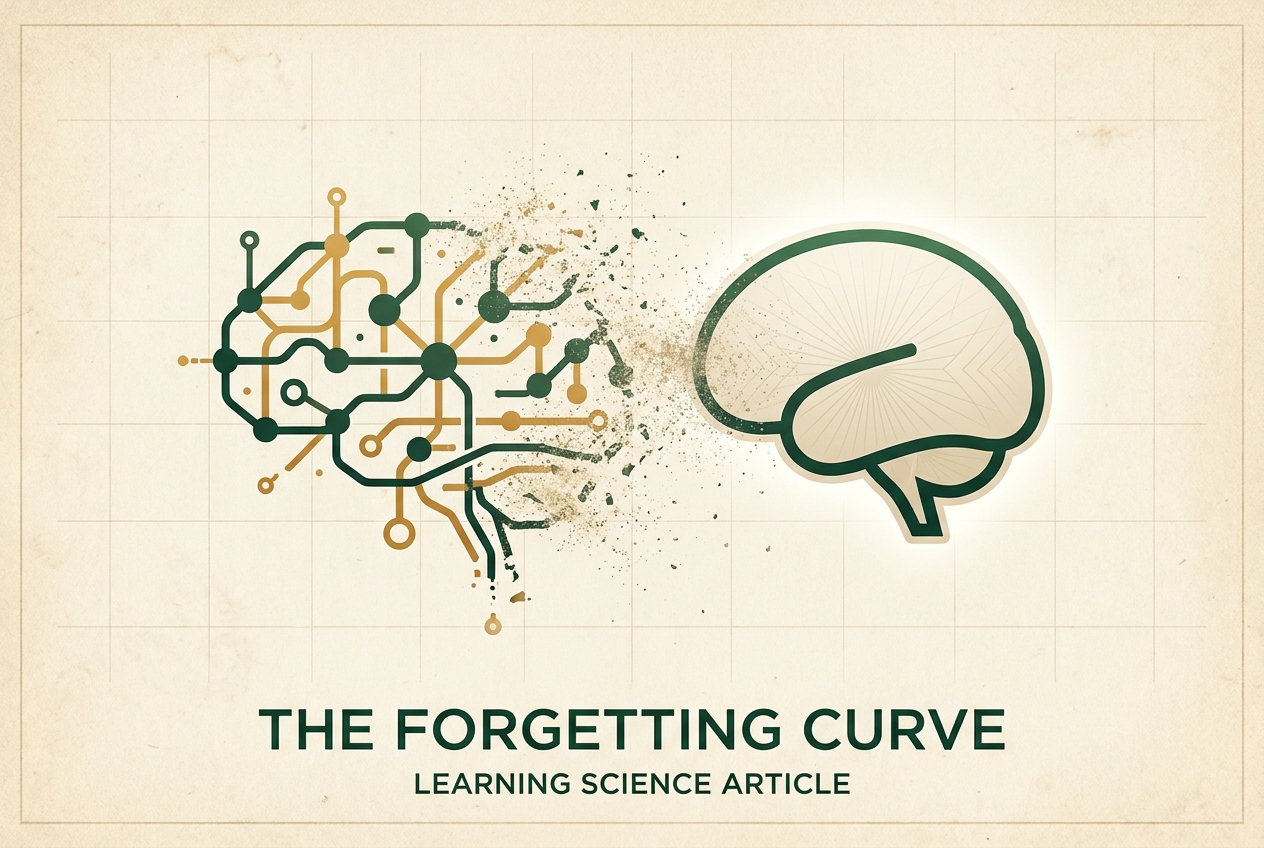
We have all been there: you finish a gripping non-fiction book, feeling enlightened and equipped with new strategies. But seven days later, when a colleague asks for your key takeaways, your mind goes blank. You might remember a single anecdote or a vague concept, but the actionable systems? Gone. This isn't a failure of intelligence; it is a biological reality known as the Forgetting Curve.
In our modern "information archipelago," where we are constantly bombarded with digital content, the ability to retain what we read is the ultimate competitive advantage. But most readers are still using study methods that were debunked decades ago. To move from passive consumption to long-term mastery, we must understand the science of memory and how to build mental maps that persist long after the book is closed. In this deep dive, we will explore the mechanisms of the brain, the data behind retrieval practice, and how visual mapping techniques can help you reclaim your intellectual sovereignty.
What Is the Ebbinghaus Forgetting Curve?
The concept of the forgetting curve was pioneered by German psychologist Hermann Ebbinghaus in 1885. Through a series of rigorous self-experiments involving the memorization of nonsense syllables, Ebbinghaus discovered that the human brain is optimized to discard information it deems unnecessary. His data revealed a steep, exponential decay in memory retention immediately after learning. Ebbinghaus was the first to quantify the "savings" of memory—how much less effort it takes to relearn information that has been previously stored.
Ebbinghaus (1885) found that without intentional review, relearning savings—a measure of how much information is retained—fell dramatically. Specifically, his classic study observed the following decay rates:
- After 20 minutes: Relearning savings dropped to 58.2%.
- After 24 hours: Retention fell further to 33.7%.
- After 31 days: Only 21.1% of the original information remained.
This suggests that within just one day, the average reader has lost nearly 70% of what they consumed. This "digital amnesia" is only compounded in 2026, where the cognitive cost of convenience often means we rely on algorithms to store our knowledge for us, rather than building the neural traces ourselves. The curve is a relentless force, but it is not an invincible one. By understanding its slope, we can identify the exact moments to intervene and "flatten" the curve before the information vanishes.
Why Passive Reading Is a Trap
The most common response to the forgetting curve is to reread. We highlight passages, underline sentences, and then go back to review those markings a week later. However, researchers have identified this as the "illusion of competence." Rereading makes information feel familiar because the brain recognizes the visual layout of the page and the flow of the sentences. But familiarity is not the same as retrieval strength. You may recognize the text when you see it, but you cannot generate the idea from scratch when you need it.
In a landmark study by Roediger and Karpicke (2006), students were divided into two groups: one that reread the material and one that practiced retrieval (testing themselves). One week later, the results were clear: the retrieval practice group retained 61% of the information, whereas the rereading group retained only 40%. More recent classroom studies in 2026 have confirmed this disparity, showing mean accuracy scores of 67.7% for active testing versus 41.3% for rereading (Nature, 2026). The message is undeniable: if you want to remember, you must stop looking at the page and start looking into your own mind.
The Science of Retrieval Practice: Rewriting the Brain
Memory is not like a muscle that gets stronger by lifting weight; it is a pathway that gets more defined every time you travel it. Every time you struggle to recall a fact from a book, you are engaging in "retrieval practice." This effortful process signals to the hippocampus that the information is high-priority, triggering neural plasticity and strengthening the memory trace. In the 2020s, advances in neuroimaging have shown that retrieval practice actually increases the density of white matter in the brain, facilitating faster communication between neurons.
Robert Bjork, a leading memory researcher at UCLA, calls this concept "desirable difficulties." Learning that feels easy is often shallow and ephemeral. When you read a summary and immediately understand it, you haven't actually learned it; you have merely recognized it. True retention requires the friction of recall. This is why "fluency" is the enemy of mastery. The more you struggle to remember a concept during a study session, the more likely you are to remember it a year from now. This counter-intuitive truth is at the heart of all effective learning systems.
How Mind Mapping Acts as an "External Brain"
If retrieval practice is the engine of memory, mind mapping is the fuel. Mind mapping leverages Dual Coding Theory, a psychological concept developed by Allan Paivio, which suggests that the brain processes verbal and visual information through separate, independent channels. When we combine text with spatial relationships (the "branches" of a mind map), we create two distinct memory traces instead of one. This redundant storage makes the information exponentially easier to retrieve.
A 2021 study by Choudhari et al. published in BMC Medical Education demonstrated the power of this approach. Medical students using visual mapping techniques saw their post-test scores jump from a pre-test mean of 4.92 to a post-test mean of 16.03. In another comparison, the mind-mapping group scored an average of 30.32, while the control group using linear notes scored only 24.60. The "gain score" for mind mapping was nearly 8 points higher than traditional methods. This isn't just a minor improvement; it is a fundamental shift in learning efficiency.
By transforming a linear book into a spatial map, you are providing your brain with a "mental atlas." Instead of searching for a needle in a haystack of text, you are looking at a landmark on a map. This spatial orientation significantly reduces the cognitive load during retrieval, allowing your working memory to focus on synthesis and application rather than just "finding" the data point.
The Architecture of a Mind Map: Building Cues for Recall
To maximize the retention benefits of mind mapping, one must understand the structural elements that trigger memory. A mind map is not just a collection of bubbles; it is a hierarchical representation of a mental model. The central node represents the core thesis—the "latitude and longitude" of the book. From there, the primary branches represent the foundational pillars of the argument. Secondary and tertiary branches provide the evidence, examples, and anecdotes that flesh out the theory.
Why does this hierarchy matter? According to the Organization-Effect in memory research, the brain is naturally adept at remembering structured information. When we impose a structure on a book's chaotic ideas, we are doing the "heavy lifting" for our long-term memory. Instead of the brain having to invent a filing system, we have provided one. This is why mind mapping is often referred to as "externalized metacognition." You are quite literally thinking about your thinking, and in doing so, you are making that thinking visible and permanent.
How to Hack the Curve: A 3-Step System for Total Retention
Knowing the science is the first step; applying it is the second. To defeat the forgetting curve and achieve long-term mastery of your reading list, follow this science-backed protocol:
- Interrupt the Decay with Immediate Mapping: Do not wait until you finish the book to take notes. Every chapter, stop and "dump" what you learned into a mind map. This forces immediate retrieval practice and utilizes the "Spacing Effect" early on. If you wait until the end of the book, you have already lost 50% of the first chapter.
- Leverage Interleaved Practice: Do not just map one book at a time. Research shows that "interleaving"—switching between different topics—improves long-term retention by forcing the brain to reload information repeatedly. Map three different books in one session to increase the "desirable difficulty." This constant context-switching prevents the brain from going onto autopilot.
- Optimal Spaced Review: Review your mind maps at increasing intervals. A review at 24 hours, 7 days, and 30 days is often enough to flatten the forgetting curve and move the information into permanent long-term storage. Each review requires less time than the previous one, as the retrieval strength grows.
Digital Amnesia in 2026: Why Maps are the Human Defense
As we navigate the year 2026, we find ourselves at a unique crossroads in human cognitive history. With the rise of agentic AI and ubiquitous search, we are experiencing what psychologists call "The Google Effect"—the tendency to forget information that can be easily found online. While this saves cognitive energy, it hollows out our "domain literacy." Without a foundation of internalized knowledge, we cannot engage in high-level critical thinking or creative synthesis. We become mere operators of tools rather than masters of craft.
Mind maps serve as the ultimate defense against digital amnesia. While an AI can summarize a book in seconds, that summary lives in the cloud, not in your neocortex. By taking the time to manually construct a mind map—or even by interacting deeply with an AI-generated map to verify and adjust its branches—you are forcing the brain to engage. You are signaling that this information is part of your identity, not just a transient data point. In a world where everyone has access to the same summaries, the person who has actually mapped the knowledge into their own brain is the one who leads. Personal knowledge management is the "new moat" in the AI economy.
Does Sleep Impact Your Mind Maps?
It is impossible to discuss memory without discussing sleep. During the REM and deep sleep cycles, the brain undergoes a process called consolidation. It "replays" the neural firings of the day, effectively moving information from the short-term storage of the hippocampus to the long-term storage of the neocortex. Sleep is not a passive state; it is a highly active period of "neural housekeeping" where the brain decides which connections to strengthen and which to prune.
Research indicates that students who study before sleeping and then review their notes the next morning have significantly higher retention rates than those who study and stay awake for the same duration. For the modern professional, this means that the 20 minutes you spend mind-mapping a book before bed might be the most productive 20 minutes of your week. You are essentially setting a "save point" in your brain's operating system.
The Future of Retention: Evidence-Based Learning as the Gold Standard
We are entering an era where "usage metrics" in education and professional development are being replaced by "outcome metrics." It is no longer enough to say you spent ten hours reading; the question is, what can you do with that information? Evidence-based learning, which centers on retrieval practice and spaced repetition, is becoming the gold standard for high-performers. Companies are increasingly looking for "T-shaped individuals" who possess both broad awareness and deep domain expertise. That depth cannot be outsourced to a chatbot.
Integrating these methods into your daily routine doesn't require hours of extra work. It requires a shift in how you spend the time you already have. Ten minutes of active mapping is worth an hour of passive rereading. This is the "Master Cartographer’s" secret: they work smarter by aligning their habits with the biological rules of the brain. They don't just consume content; they build intellectual capital.
Key Takeaways for Master Cartographers
- The 70% Rule: You will forget the majority of a book within 24 hours unless you actively intervene with retrieval practice.
- Retrieval > Rereading: Self-testing and active recall are 50% more effective than passive review, as shown in the Roediger & Karpicke (2006) study.
- The Visual Advantage: Mind mapping increases retention scores by approximately 10-15% compared to linear notes by leveraging Dual Coding Theory (Choudhari et al., 2021).
- Desirable Difficulty: If learning feels hard, it is working. The struggle of recall is the signal for neural growth. Avoid the "illusion of competence" that comes from rereading.
- Consolidation is Key: Sleep is the final step in the mapping process. Study before bed to maximize the brain's natural consolidation mechanisms.
Featured Reading: To dive deeper into the science of how we learn, we highly recommend Make It Stick: The Science of Successful Learning by Peter C. Brown, Henry L. Roediger III, and Mark A. McDaniel. This book is the definitive guide to the research mentioned in this article.
Summary Maps is designed specifically to solve the problem of the forgetting curve. By providing visual mental models of the world's most important books, we give you the landmarks you need to navigate the intellectual landscape with confidence. We bridge the gap between "reading for information" and "reading for understanding." Don't just read; map your way to mastery.