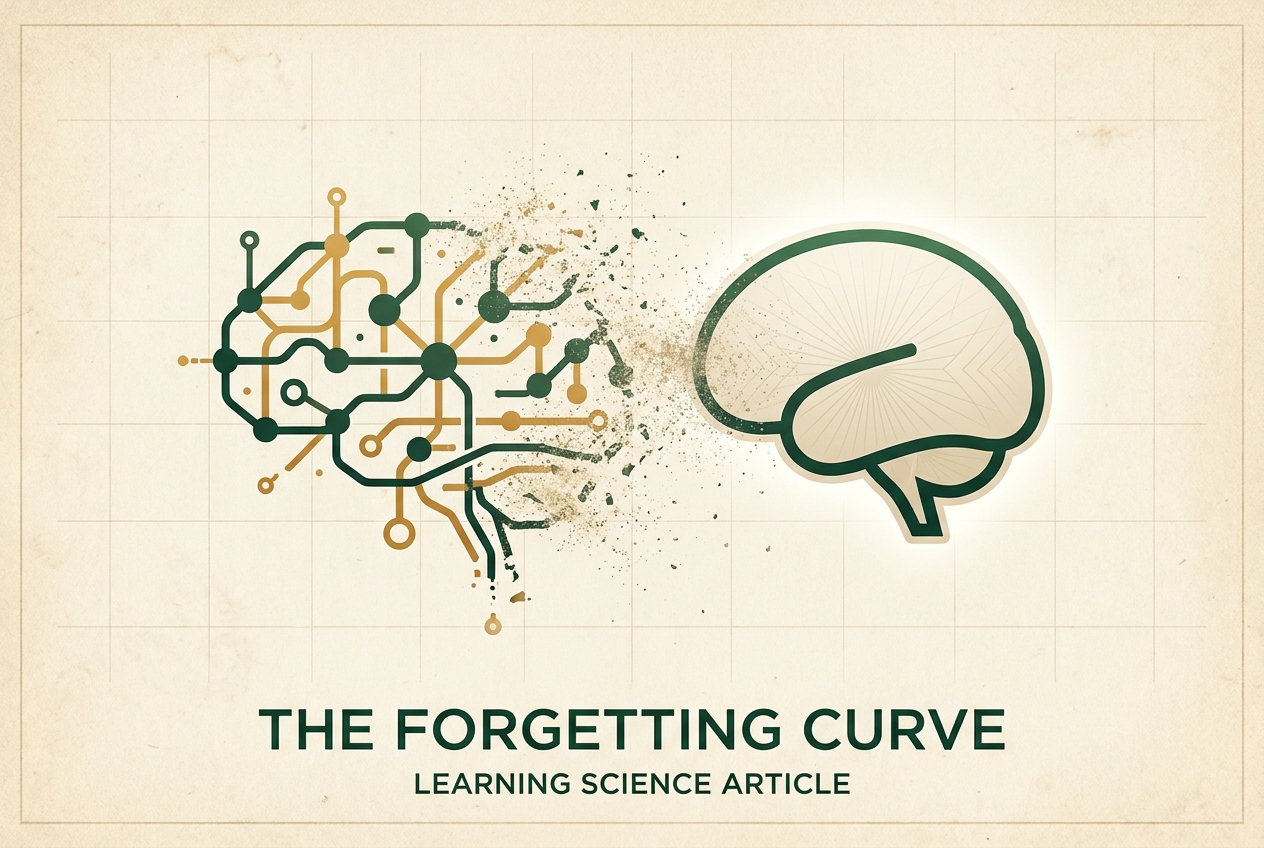
Finishing a chapter can feel like learning, but the real test is what you can still explain tomorrow. Memory is not a file that gets saved the moment your eyes pass over a sentence. The brain has to encode new information, connect it with what you already know, and keep it available for later use. Sleep is one part of that process, which is why a good study plan should include not just what you read, but what happens after you close the book.
The practical lesson is not that sleep magically turns every page into permanent knowledge. It is that attention while learning, a chance to retrieve the ideas, and enough rest work together. A chapter summary or mind map can help you organize the material, while a night of sleep gives the brain time away from new input. The most useful approach is to make your understanding visible before bed, then try to recall it again later.
Does sleep actually help memory?
Yes, sleep supports memory, but the benefit depends on what you learned, how well you paid attention, and how much sleep you get. Memory researchers use the word consolidation for processes that stabilize and reorganize a new memory after learning. During sleep, the brain is not simply switched off. Neural activity patterns associated with recent experience can be reactivated, and information may become more integrated with existing knowledge. Researchers continue to study the exact mechanisms, so it is better to describe sleep as a useful condition for memory processing than as a guaranteed memory upgrade.
A well-known experiment illustrates why the hours before learning matter too. In a 2007 study, Yoo and colleagues found that sleep-deprived participants were substantially worse at forming new memories than rested participants, alongside reduced activity in the hippocampus, a brain structure important for new episodic memories. A Harvard Gazette report on the study described the loss in memory-formation capacity as reaching about 40 percent after a sleepless night (Yoo et al., 2007; Harvard Gazette, 2007). That figure is a finding from a controlled experiment, not a prediction that every person who sleeps poorly will forget 40 percent of a book.
Sleep after learning matters as well. Wang and colleagues compared a 30-minute period of sleep, quiet eyes-closed rest, and an active distractor task after participants completed memory tasks. The groups included 24 people in the sleep condition, 22 in quiet rest, and 29 in the distractor condition. Both sleep and quiet rest led to better performance than the distractor task in that short interval, and the benefits of rest and sleep were indistinguishable in this experiment (Wang et al., 2021). The result suggests that a calm pause can help protect freshly learned material from interference. It does not mean a brief break replaces regular nighttime sleep.
What happens to a new memory while you sleep?
When you read a chapter, your brain encounters a stream of details: names, explanations, examples, and transitions. Some details are encoded strongly because they are meaningful or receive focused attention. Others fade quickly, especially if you skim while distracted. Sleep can support the further processing of those traces, but it cannot reliably rescue material that was never understood or attended to in the first place.
One leading account is that the brain reactivates patterns related to recent learning and gradually links them with broader knowledge. Think of the chapter as a new neighborhood in a larger mental map. Initial reading marks a few landmarks. Retrieval practice asks you to find your way back without looking. A mind map makes the important roads and connections explicit. Rest gives the brain time away from incoming information, and sleep provides a broader biological setting in which memory consolidation can occur. The map is a learning aid, not a literal picture of the brain’s activity.
This also explains why memory is not a perfect recording. Consolidation can preserve central ideas while details become less accessible, and later knowledge can reshape how we recall an event or concept. A useful reader therefore needs more than rereading. You need to decide what the author was arguing, connect it to prior knowledge, and practice retrieving it later.
Is sleep more important before or after reading?
Both timing windows matter, for different reasons. Sleep before a study session helps you arrive more alert and ready to encode new information. The Yoo et al. finding focused on memory formation after sleep loss: sleep deprivation interfered with the brain’s ability to make new memories. Sleep after learning supports the stabilization of material already encountered. Those are related but distinct jobs.
For readers, the implication is straightforward: do not plan an important learning session at the end of an all-nighter, and do not routinely trade sleep for one more passive rereading. If you study in the evening, finish with a short attempt to recall the chapter, jot down what remains unclear, and go to bed at a sensible time. If you study earlier, take a few minutes of quiet rest before filling the next hour with messages, videos, or unrelated work.
The Centers for Disease Control and Prevention recommends that adults get at least seven hours of sleep per night. That is general health guidance, not a promise that seven hours is the precise amount every individual needs. It is a useful baseline for planning: protect a regular sleep opportunity rather than treating recovery as optional study time.
How can you combine reading, retrieval practice, and a mind map?
A mind map becomes more valuable when it is built from memory instead of copied line by line. Copying can keep your eyes busy without showing whether you can reconstruct the idea. Start with a small section, close the source, and draw the main concept from memory. Then reopen the chapter to correct gaps and add only the details that clarify relationships.
Set a question before you read. Turn a heading into a prompt such as “What problem is this chapter solving?” A question gives your attention a target and creates a retrieval cue for later.
Read a manageable section. Pause at a natural break rather than stopping after every sentence. Mark only a few terms that seem central, and notice how examples support the main claim.
Close the book and retrieve. Explain the section aloud or write a few sentences without checking. If you cannot recall a point, treat that as useful feedback about what needs another look, not as a reason to reread the entire chapter.
Draw a rough mind map from memory. Put the chapter’s core question or claim in the center, then add branches for the main ideas, evidence, examples, and implications. Use connecting words to show relationships such as “causes,” “contrasts with,” or “depends on.”
Check the source and repair the map. Add missing links, correct misunderstandings, and remove details that do not support the central structure. Keep the memory-built draft visible so you can see what you retrieved accurately and what needed support.
Make a brief book summary. Write a short paragraph in your own words that captures the author’s main argument and why it matters. The map shows relationships at a glance; the paragraph checks whether you can explain them coherently.
Return later for another retrieval attempt. The next day, cover the map and reconstruct the branches or answer your original question. After that, revisit the most important ideas again after a longer interval that fits your schedule. The goal is repeated effortful recall, not a rigid calendar that ignores your workload.
This sequence connects three useful activities. Reading supplies the material; retrieval practice makes you bring it back; mapping helps you see how separate points fit together. A book summary then compresses that structure into a portable explanation. None of these tools has to be elaborate. A rough map you can explain is more valuable than a polished page you merely copied.
Can quiet rest help if you cannot sleep right after studying?
A short, quiet pause may be worthwhile. In the Wang et al. (2021) experiment, eyes-closed rest after learning performed similarly to sleep over the brief retention period and better than an active distractor condition. Earlier work by Dewar and colleagues also found that quiet rest after learning stories was associated with better later memory than a nonverbal distractor task, including a test a week later (Dewar et al., 2012, as discussed by Wang et al., 2021).
Do not turn these results into a claim that rest and sleep are interchangeable. The experiments tested defined tasks and short periods, not the demands of a full week of learning. If you have a few minutes after reading, put the phone aside, sit quietly, and let your thoughts settle. If it is bedtime, prioritize a normal sleep schedule instead of trying to optimize a laboratory effect.
What is a realistic evening study routine?
Try a routine that leaves room for ordinary life rather than treating every chapter like an exam. First, choose one section and identify its main question. Read with a pencil or notes app nearby, but do not transcribe every sentence. At the end, close the book and make a three-part recall: the main claim, two supporting ideas, and one question you still have.
Next, sketch a quick map with the main claim in the center. Add a branch for evidence, another for examples, and one for how the chapter connects to something you already know. Use a different color only if it helps you distinguish categories; color itself is not a memory trick. Write a short summary from the map, then compare your explanation with the original text. Finish by recording one question to answer tomorrow. If you have time, take a brief quiet break before switching to something else.
In the morning or at your next study session, try to redraw the map before opening your notes. This is retrieval practice, not a test of whether you have a perfect memory. Check the source afterward and update the parts you missed. The effort of trying to remember is the point: it reveals what is accessible and makes the next review more targeted.
How should you think about sleep and memory without overpromising?
Sleep is important, but it is one part of a system. It cannot guarantee that every sentence will be retained, and a beautiful diagram cannot replace understanding. The most dependable study routine combines enough attention to understand a passage, some effort to recall it, a structure that connects ideas, and regular rest. For adults, the CDC’s seven-hour recommendation offers a practical minimum baseline, while individual needs can vary.
It is also worth noticing the difference between familiarity and recall. Rereading a paragraph can make it feel easy because the words are in front of you. When you close the book, the real question is whether you can explain the idea and how it connects to the rest of the chapter. A mind map built from memory makes that distinction visible. A compact summary turns it into language you can share or revisit later.
For a nonfiction book, try mapping one chapter at a time, then create a single overview that links the chapters to the book’s central argument. Revisit that overview after sleep and see which branches return without prompting. The map is not a substitute for the author’s full reasoning; it is a scaffold for retrieving and organizing it. This is where book summaries and mind mapping work naturally together: summaries preserve the core message, while a map shows how the message is assembled.
Key Takeaways
Sleep supports memory formation and consolidation, but it cannot replace attention, comprehension, or practice recalling what you read.
Sleep before learning matters for encoding; sleep after learning supports further processing. Avoid treating late-night rereading as a substitute for rest.
Research by Wang et al. (2021) found benefits of both sleep and quiet rest over an active distractor in a brief post-learning experiment. The result does not make a short pause equivalent to a full night’s sleep.
Adults are generally advised by the CDC to get at least seven hours of sleep per night, though personal needs vary.
Read a section, close the book, retrieve its main ideas, and sketch a mind map from memory. Then check and repair the map.
Use a short book summary to explain the central argument in your own words, and return later to test what you can still recall.