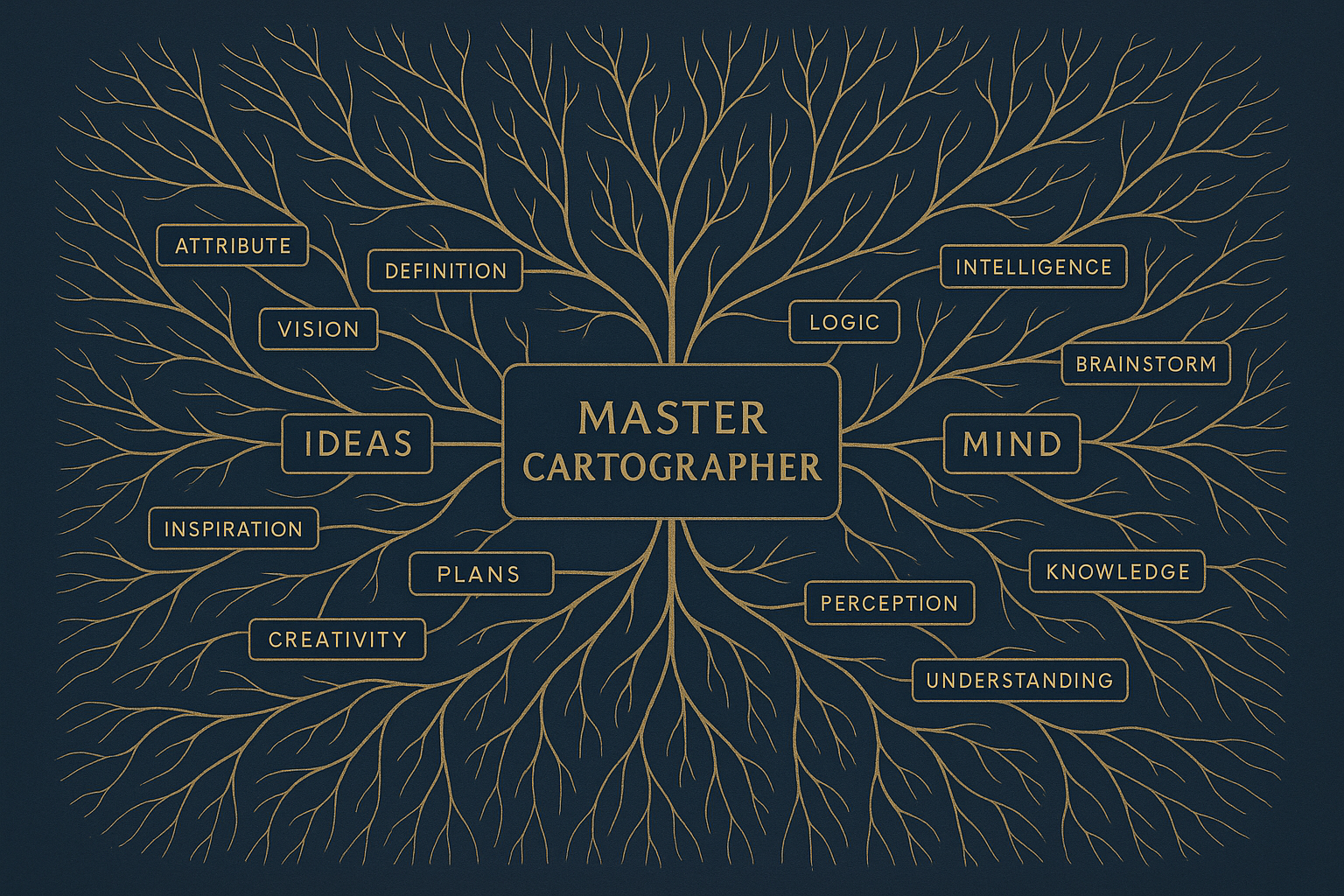
A difficult chapter rarely defeats us because every sentence is impossible. More often, the problem is that definitions, evidence, examples, and exceptions arrive one after another, while our attention has to keep track of how they fit together. A mind map can help by making those relationships visible. Used well, it is not a colorful substitute for reading or a magic memory device. It is a compact working model of what the chapter says and how its ideas connect.
This guide focuses on one concrete task: learning from a challenging nonfiction or textbook chapter. You will build a map in stages, check it against the source, and use it to retrieve and apply the ideas later. The method draws on dual coding theory, concept-mapping research, and the practical mind-mapping tradition associated with Tony Buzan, while keeping the limits of the evidence in view.
Why map a chapter instead of copying notes?
Linear notes are useful when you need a record of what happened in sequence. A chapter, however, often contains several kinds of relationships at once: a central claim supported by reasons, a process with stages, a comparison between competing explanations, or a principle illustrated by cases. If every item is written in the order it appears, the structure can remain hidden.
A mind map puts a central question or topic in the middle and arranges related ideas around it. Branches make hierarchy visible; labeled connections make relationships explicit. This gives you a surface to inspect: Is this claim evidence, an example, a counterargument, or a consequence? Does one idea depend on another? What is missing?
That last question matters. Allan Paivio's dual coding theory describes verbal and nonverbal imagery systems that can work together in memory. A map combines short verbal labels with a spatial arrangement, and may include a meaningful sketch or symbol. The theory is a reason to test a well-designed visual representation, not proof that every diagram improves learning. Decorative icons, excessive color, and copied pictures can add visual noise rather than useful cues. (Paivio, 1991; Clark & Paivio, 1991.)
Mind maps and concept maps are related but not identical. A classic mind map radiates from a central topic and often uses keywords; a concept map typically uses labeled links to express propositions between concepts. For difficult reading, borrowing from both is useful: keep the map spacious and radial, but label important links with verbs such as “causes,” “requires,” “contrasts with,” or “is evidence for.”
What does the research actually say?
The evidence encourages careful experimentation, not grand promises. In a randomized study of medical students learning from a 600-word passage, Farrand, Hussain, and Hennessy (2002) reported about a 10% adjusted advantage in factual recall after one week for the mind-map group. The 95% confidence interval ran from -1% to 22%, so the estimate was imprecise and compatible with little or no benefit. It is a promising result, not a guarantee that mind maps produce a fixed recall boost.
Broader concept-map evidence is also encouraging but should not be mistaken for a mind-map-only result. Nesbit and Adesope's 2006 meta-analysis synthesized 55 studies with 5,818 participants and found a positive overall learning effect for knowledge and concept maps. Outcomes varied with how maps were used, what learners did, and what instruction was used for comparison. One practical implication is to construct or revise a map, not merely look at a finished diagram.
Dual coding theory provides a model for why pairing words with meaningful visual organization may help; it is not a statistic or a promise of a “visual learner” advantage. People do not need to be sorted into fixed visual, auditory, or kinesthetic learning-style categories to benefit from clear organization. Ebbinghaus's historical forgetting-curve experiments, meanwhile, are often summarized as showing roughly one-third savings in relearning after a day. That is a savings measure from a particular laboratory task, not a universal percentage of information a person forgets. Its useful lesson here is modest: a map made once is not enough; revisit the material and try to retrieve it.
Tony Buzan popularized the radiant mind-map format and described seven design laws in The Mind Map Book, including emphasis, association, hierarchy, and using key words and images. These are design recommendations, not seven experimentally validated laws of memory. Use them as prompts for a readable map, then judge the map by whether it helps you explain, recall, and use the source.
A step-by-step method for mapping a hard chapter
Imagine reading a chapter on how teams make decisions under uncertainty. Its sections cover bounded rationality, evidence quality, cognitive bias, decision rules, and review after outcomes. Instead of copying every paragraph, build a map that answers a real question: “How can a team make a defensible decision when information is incomplete?”
- Preview for structure, not detail. Read the title, introduction, headings, conclusion, diagrams, and review questions. Write one central question on a blank page. A useful center is a problem or inquiry, not a vague label such as “Chapter 4.” This gives your reading a destination without deciding the answer in advance.
- Read a small section and pause. Work through one heading or a few pages at a time. Afterward, look away from the text and write what the section was mainly saying in a short phrase. This retrieval pause exposes gaps that highlighting can hide. If you cannot summarize it, reread the relevant passage before adding detail.
- Choose a handful of first-level branches. In our example, the branches might be “Define the problem,” “Assess evidence,” “Generate options,” “Choose a rule,” and “Learn from outcomes.” Use the chapter's actual logic; do not force every chapter into the same template. Branches should be categories that help answer the center question.
- Put one idea on each twig. Add concise keywords, not paragraphs. Under “Assess evidence,” branches might include source reliability, sample size, missing data, and uncertainty. Under “Generate options,” add alternatives and constraints. A keyword should cue an explanation that you can supply aloud, rather than serve as a script you merely reread.
- Label the relationships that matter. Add small link labels where placement alone is ambiguous: “limits,” “supports,” “depends on,” “trade-off,” “example of.” If two branches influence each other, connect them with a line and state why. For instance, “missing data” may “increase uncertainty,” which “changes the decision threshold.” A link label turns a cluster into a claim you can test.
- Mark evidence and uncertainty distinctly. Use a consistent symbol or color to distinguish a definition, a finding, an example, and a question. Do not encode so many categories that you need a legend to decode the page. Mark one disputed point with a question mark and return to the passage or another credible source to verify it.
- Close the book and reconstruct. On a fresh page or blank canvas, redraw the major branches from memory. Compare with the source map, correct errors in another color, and note missing relationships. This is a check on what you can retrieve, not a test of artistic skill.
- Apply one connection to a real case. For the decision chapter, choose an upcoming or historical decision. Map its goal, evidence, options, uncertainty, rule, and review signal. If the chapter's concepts cannot help you analyze a case, decide whether you misunderstood them or need a different kind of map.
Keep the first pass intentionally rough. A map should be edited, not perfected while reading. If you spend more time choosing colors than deciding whether “evidence supports claim” or “example illustrates claim,” the visual polish is taking over the learning task.
How do you make the map useful after reading?
Turn the map into a retrieval tool. Cover the branches and name them from the center outward. Cover the center, inspect a branch, and explain how it contributes to the chapter's answer. Then choose two distant branches and explain their relationship. These prompts are harder than recognition, which is why they can reveal whether the map represents understanding or just familiar words.
- Same day: Do a two-minute blank-page reconstruction, then check the source and fix inaccuracies.
- Next day: Explain the central question and the main branches without reading. Add only the missing connection you discover.
- Several days later: Use the map to answer a new question, solve a problem, or explain the idea to another person. Then update it with a counterexample or boundary condition.
This schedule is a practical routine, not a scientifically exact interval formula. The specific spacing that works depends on the material, stakes, and what you can already retrieve. Ebbinghaus's work is a reminder that repeated retrieval and relearning matter; it does not mean a particular map is immune to forgetting.
For a complex subject, maintain two views: a compact overview for the chapter's argument and a separate detail map for a mechanism or comparison. If the overview becomes crowded, split a branch into its own map and link it back to the central question. Digital mapping tools make rearranging and cross-linking easy; paper can make it easier to see the whole structure at once. The best medium is the one that makes revision and recall easy for you.
Common mistakes that make a mind map less effective
- Transcribing instead of synthesizing: Long copied sentences turn branches into a cramped outline. Reduce an idea to a prompt you can explain, but keep technical terms precise.
- Confusing proximity with logic: Two items beside each other may look related without showing how. Label the link or separate them.
- Adding every detail at the same level: A definition, key claim, minor anecdote, and footnote should not compete for equal visual weight. Use hierarchy to signal importance.
- Overdecorating: Color and imagery help when they distinguish categories or make a concept memorable. Random embellishment consumes attention and can obscure the structure.
- Believing familiarity is mastery: A neat map can feel satisfying while you still cannot explain it. Close the map and test recall; correct it using the book, not your confidence alone.
- Treating the source as infallible: Keep a “verify” mark for claims that are surprising, consequential, or weakly supported. A learning map should preserve uncertainty as well as conclusions.
These cautions connect the method to cognitive load: a diagram can lower the effort needed to see relationships, but clutter, redundant decoration, and unexplained symbols can add work. Use only visual features that answer a question: What is central? What supports it? What differs? What remains uncertain?
A quick quality check before you finish
Before calling a chapter map done, ask yourself five questions:
- Can I state the central question and the author's answer in my own words?
- Can I point to the strongest supporting reason and describe why it supports the answer?
- Have I distinguished the source's evidence from its examples and my own interpretation?
- Can I explain at least one connection between branches without looking at the text?
- Do I know what needs verification, and can I use the map to analyze a new case?
If one answer is no, that is not a failure. It tells you what to do next: reread a passage, add a labeled relationship, or retrieve the idea again later. A useful mind map is a working model that improves as your understanding improves, not a finished poster that proves you studied.
Key Takeaways
- Use a mind map to reveal the argument and relationships in a specific chapter, not to decorate copied notes.
- Pair concise words with meaningful spatial structure, in line with dual coding theory, while remembering that design quality and task matter.
- Research offers a promising but qualified picture: mind-map and concept-map findings vary, and one small study's estimated 10% recall advantage had a confidence interval crossing zero.
- Construct the map, label causal or evidential links, then close the source and reconstruct from memory.
- Revisit the map through retrieval and apply it to a real question; do not assume a single study session prevents forgetting.
- Keep the map legible, distinguish evidence from interpretation, and preserve uncertainty rather than forcing false certainty.
References
- Buzan, T., & Buzan, B. (2010). The Mind Map Book: Unlock Your Creativity, Boost Your Memory, Change Your Life. BBC Active. (First published in 1993.)
- Clark, J. M., & Paivio, A. (1991). Dual coding theory and education. Educational Psychology Review, 3, 149-210. https://doi.org/10.1007/BF01320076
- Ebbinghaus, H. (1885/1913). Memory: A Contribution to Experimental Psychology. Trans. H. A. Ruger & C. E. Bussenius. https://psychclassics.yorku.ca/Ebbinghaus/
- Farrand, P., Hussain, F., & Hennessy, E. (2002). The efficacy of the mind map study technique. Medical Education, 36(5), 426-431. https://pubmed.ncbi.nlm.nih.gov/12028392/
- Murre, J. M. J., & Dros, J. (2015). Replication and analysis of Ebbinghaus' forgetting curve. PLoS ONE, 10(7), e0120644. https://doi.org/10.1371/journal.pone.0120644
- Nesbit, J. C., & Adesope, O. O. (2006). Learning with concept and knowledge maps: A meta-analysis. Review of Educational Research, 76(3), 413-448. https://doi.org/10.3102/00346543076003413
- Paivio, A. (1991). Dual coding theory: Retrospect and current status. Canadian Journal of Psychology, 45(3), 255-287. https://doi.org/10.1037/h0084295