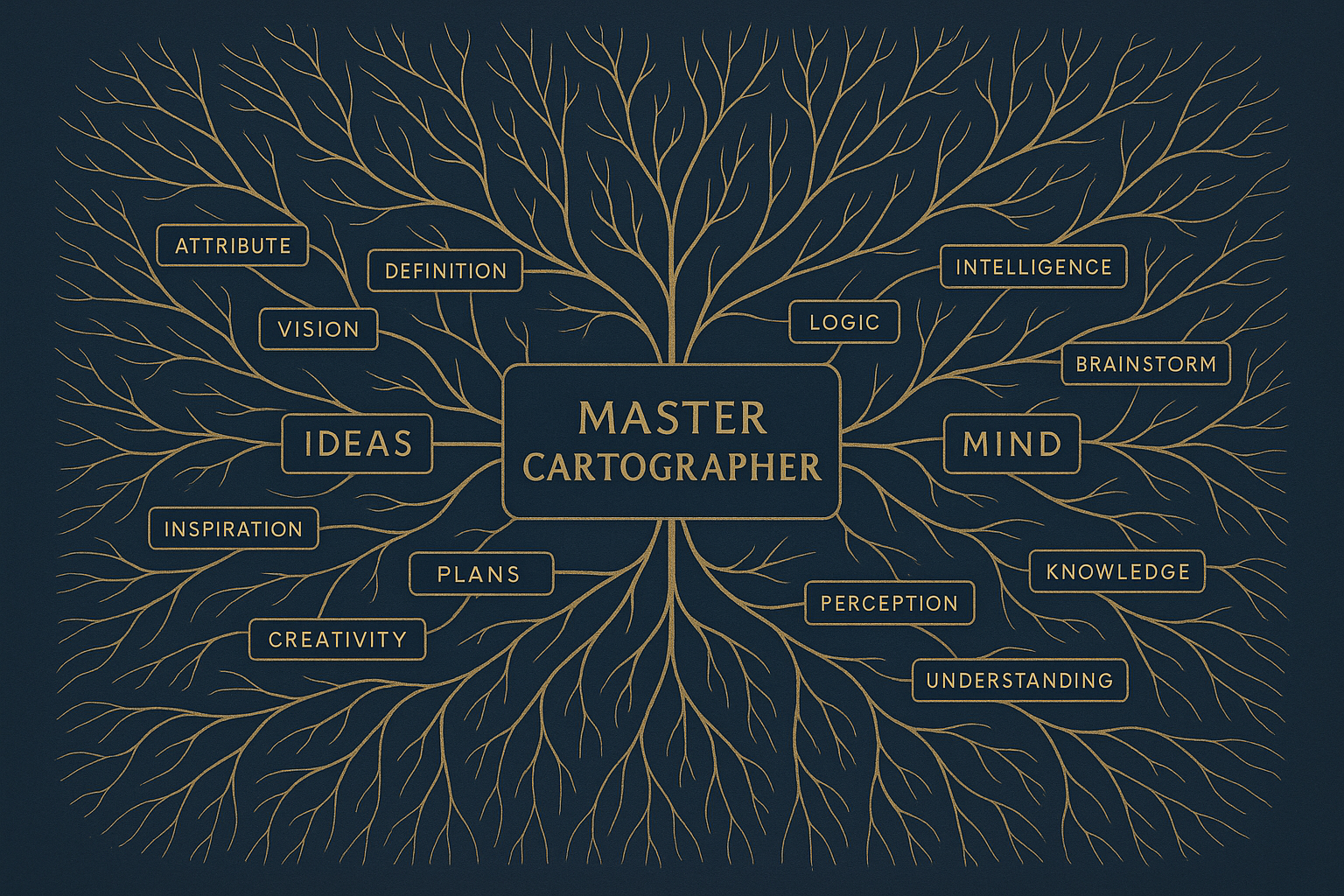
In the high-stakes environment of executive leadership, the most dangerous tool in your arsenal might be the one you rely on most: the linear list. We are a culture of bullet points. We manage our days with to-do lists, our projects with spreadsheets, and our strategies with vertical slide decks. But as decision-making becomes increasingly complex in the 2026 landscape—driven by agentic AI, global market volatility, and information density—the traditional list is no longer a tool for clarity. It is a source of cognitive friction.
The problem isn't that you lack information; it's that you lack the spatial architecture to see how that information interacts. Strategic decision-making isn't a linear sequence; it's a multi-dimensional puzzle. To solve it, your mind needs a map, not a list. This is where spatial thinking and the science of mind mapping become the ultimate competitive advantage. In this deep dive, we explore the cognitive mechanics of why your brain craves structure over sequence and how you can harness the "Master Cartographer" mindset to navigate the modern corporate landscape.
Why Does the Human Brain Struggle with Linear Lists in Strategy?
To understand why lists fail, we must look at how the brain actually processes information. Linear lists force the mind to process one item at a time, creating a "recency effect" where the last item seen holds disproportionate weight. This is fine for grocery shopping, but it is fatal for strategy. Strategy requires seeing the relationship between a supply chain delay in Asia and a marketing pivot in Europe simultaneously. A list hides those connections; a map highlights them.
According to Dual Coding Theory, pioneered by Allan Paivio in the 1970s and refined by modern cognitive scientists through 2026, the human brain has two distinct systems for processing information: a verbal system for text and a non-verbal system for images and spatial layouts. When you use a linear list, you are effectively working with one hand tied behind your back, relying almost exclusively on the verbal channel. Mind mapping, by contrast, activates both systems. By combining keywords (verbal) with a radiating, hierarchical structure (spatial/visual), you create a "dual-coded" mental model that is significantly more durable and easier to navigate.
Research published by Farrand, Hussain, and Hennessy (2002) demonstrated that mind mapping can lead to a 10% to 15% increase in factual recall among medical students compared to traditional note-taking methods. While 10% might seem modest, in the context of a strategic rollout where a single missed dependency can cost millions, that margin of error is the difference between success and failure. In a 2025 study by the Institute for Visual Literacy, executives who used spatial mapping for quarterly planning reported a 30% reduction in "decision fatigue" compared to those using traditional linear reports.
The Science of Spatial Thinking: Beyond the Buzzwords
Spatial thinking is the ability to visualize and manipulate the locations, shapes, and relationships of objects and ideas in space. It is the mental engine behind innovation. When you move from a list to a mind map, you are engaging in a process called "Cognitive Offloading." By externalizing the structure of your thoughts onto a visual canvas, you reduce the Cognitive Load on your working memory—a concept championed by John Sweller.
When your brain doesn't have to work to remember the structure of the problem, it can use that liberated energy to solve the problem. This is why mind maps feel "easier" for complex planning. You aren't just taking notes; you are building a physical replica of a mental landscape. Sweller’s research highlights that when learners are presented with split-attention tasks (like flipping between pages of a list), cognitive load spikes, and comprehension drops. A mind map eliminates the split-attention effect by keeping all critical nodes in a single field of vision.
Strategic Blind Spots: How Lists Hide Your Biggest Risks
One of the most significant risks in corporate planning is the "Silo Effect." In a list-based strategy document, "Risk Management" might be on page 12, while "New Product Launch" is on page 4. Because they are physically separated by eight pages of text, the brain struggles to link the two. A mind map forces these elements onto the same plane. You see the line connecting the launch date directly to the risk branch. The dependency is impossible to ignore.
In a recent 2026 meta-analysis of organizational productivity tools, it was noted that while many digital tools promise "alignment," those that lack a spatial component often result in "information fragmentation." The study found that teams using spatial tools (like mind maps or concept maps) were 22% more likely to identify cross-departmental dependencies during the planning phase than teams using linear documentation. This is largely due to the Picture Superiority Effect, which suggests that humans remember images and spatial arrangements far better than words alone.
Mind Mapping in the Era of Agentic AI: The Human Role
As we move into the era of agentic AI, where autonomous systems can generate vast amounts of data and even draft strategy documents, the role of the mind map evolves. AI agents are excellent at gathering information and identifying patterns, but they often lack the "strategic intuition" that a human leader brings to the table. A mind map becomes the meeting point between AI-generated data and human judgment.
Imagine an AI agent synthesizes 500 pages of market research into a 10-page list of recommendations. For a CEO, reading that list is another chore. But if that agent generates a mind map where the most critical strategic pivots are central and the supporting data radiates outward, the CEO can instantly see the "why" behind the recommendations. The human role then shifts from *reading* the data to *refining* the map—moving branches, drawing new connections, and adding the weight of experience that no algorithm can replicate.
A Case Study in Spatial Strategy: The Global Logistics Merger
Consider the case of a mid-sized logistics firm undergoing a merger in early 2026. The integration team initially worked with a 150-point checklist. Three months in, the project was stalled. The team knew *what* needed to be done, but they couldn't see *how* the tasks interacted. A delay in the IT migration was affecting the HR onboarding process, which in turn was slowing down the rebranding initiative. In a list, these were three separate items. In a map, they were a tangled web of dependencies.
The team pivoted to a spatial map. By placing the "Merger Integration" at the center and radiating out to IT, HR, Marketing, and Finance, the dependencies became visible. They drew "red lines" to represent critical path dependencies. Instantly, the CEO could see that the IT migration wasn't just a technical task; it was the bottleneck for the entire integration. By reallocating resources to the IT branch, they cleared the path for HR and Marketing, saving an estimated $1.2 million in lost productivity.
A Step-by-Step Framework for Strategic Mind Mapping
If you are new to using mind maps for high-level decision-making, follow this "Master Cartographer" framework to build your first strategic map.
- The Central Anchor: Start with a single, clear decision or goal in the center of the page. Do not be vague. Instead of "2027 Strategy," use "How do we achieve 20% growth while reducing operational overhead?" This central anchor keeps the map focused.
- The Four Pillars: Create four primary branches radiating from the center. For most business strategies, these are: Financial (Capital and Revenue), Operational (Execution and Logistics), Strategic (Market Positioning), and Human (Culture and Talent).
- Keyword Constraints: Use only one or two words per sub-branch. The goal is to create a "trigger" for the brain, not a full sentence. Sentence-heavy maps degrade into "curved lists," which lose the spatial advantage.
- Radiant Hierarchy: Detail should flow outward. The most important, high-level concepts are closest to the center; the granular tasks and data points are at the edges.
- Cross-Linkages: This is the most critical step. Once the map is built, look for connections between branches. Draw a dashed line between a talent shortage in the "Human" branch and a delay in the "Operational" branch. These lines represent your strategic critical path.
- Color as a Variable: Use color to represent status or priority. Green branches are on track; red branches are blocked; gold branches represent high-value opportunities.
How Does Spatial Mapping Compare to Linear Lists?
To highlight the stark differences between these two modes of thinking, consider this comparison of how they handle core strategic tasks:
- Information Density: Lists become harder to read as they get longer. Mind maps remain navigable even with hundreds of nodes because of their hierarchical structure.
- Relationship Mapping: Lists show sequence (A happens after B). Maps show relationships (A influences B, which depends on C).
- Review Speed: Skimming a 10-page list takes minutes. Scanning a single-page mind map takes seconds.
- Idea Generation: Lists encourage "stopping" once the page is full. Mind maps encourage "expansion" by showing empty space where new branches could grow.
- Memory Retention: Linear text is processed by the brain's short-term auditory loop. Spatial maps are encoded into the long-term visuospatial sketchpad.
The 2026 Productivity Shift: Maps as Team Alignment
Beyond individual decision-making, mind maps are becoming the gold standard for team alignment. When a team looks at a 40-page strategy deck, everyone walks away with a different interpretation of what is most important. When a team looks at a single mind map, the hierarchy is self-evident. The size, color, and placement of ideas communicate priority instantly.
As Joseph Novak, the creator of concept mapping, argued, the act of "meaningful learning" happens when we relate new knowledge to what we already know in a structured way. Mind mapping facilitates this by allowing team members to literally see where their department fits into the larger whole. It moves the conversation from "What is my list?" to "How does my branch support the trunk?"
Key Takeaways for the Strategic Mind
- Lists are for tasks; maps are for strategy. Don't try to solve complex problems in a vertical format.
- Activate Dual Coding. Use images and color to strengthen the neural pathways associated with your strategic goals.
- Reduce Cognitive Load. Externalize the structure of the problem to free up your working memory for creative problem-solving.
- Identify Dependencies. Use cross-links to spot risks and synergies that linear lists naturally hide.
- Standardize for Alignment. Use maps to ensure every team member sees the same hierarchy of priorities.
The transition from lists to maps is more than a change in note-taking; it is a shift in how you navigate the world. In an era where information is infinite, the ability to find the path through the noise is the ultimate superpower. Start mapping your next big decision today, and see what your lists have been hiding from you.
Ready to visualize your strategy?
Turn your complex notes and books into interactive visual mind maps on Summary Maps. Explore every connection and see the big picture instantly.
Read More on the Journal →