Most of us take notes the way we were taught in school: top to bottom, line by line, in the order the information arrived. It works well enough for a shopping list. It works much less well for a 300-page book, a semester of lectures, or a project with a dozen moving parts, because the thing you actually need to remember is not the order of the sentences. It is how the ideas connect.
A mind map is a simple fix for that problem. You put one topic in the middle of the page, branch the main ideas out from it, and hang the details off those branches. The result is a one-page picture of how a subject fits together. This guide explains what the research does (and does not) say about why that helps, then walks you through building your first map step by step.
What is a mind map?
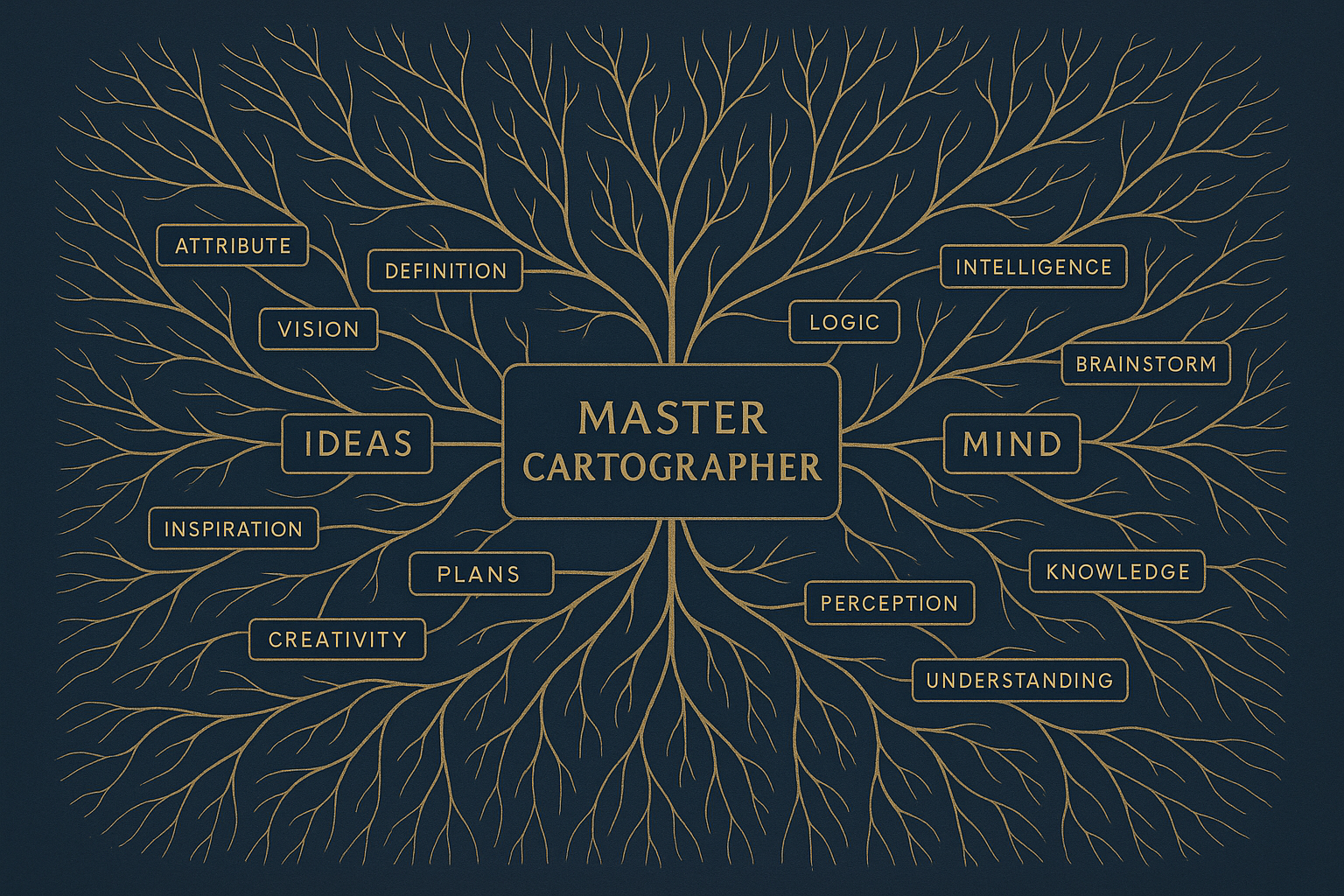
A mind map is a diagram that organizes information around a single central idea. Main themes radiate out as thick branches; supporting details sit on thinner branches further out. Most mind maps use short keywords instead of full sentences, and many add color and small images to make each branch easy to tell apart.
The format was popularized by the British author and broadcaster Tony Buzan, whose 1974 book and BBC television series Use Your Head introduced "mind mapping" to a wide audience. The idea of drawing knowledge as a branching diagram is much older, though. The third-century philosopher Porphyry used tree diagrams to classify concepts, and educators have used branching outlines for centuries.
Mind maps vs. concept maps
The two terms are often used interchangeably, but they are different tools:
- Mind maps have one central topic and a hierarchy of branches. They are fast to draw and ideal for summarizing a book chapter, brainstorming, or planning.
- Concept maps were developed by Joseph Novak and his team at Cornell University in the 1970s. They can have several key ideas, and the lines between them carry labels such as "causes," "leads to," or "is a type of." They take longer to build but are better at showing how ideas relate.
Much of the best research on visual note-taking was done on concept maps, so it is worth knowing the difference when you read claims about "mind mapping."
Does mind mapping actually improve memory?
Yes, with some honest caveats. Here is what the published research supports.
1. Mapping beats rereading and passive listening
The most-cited review is a 2006 meta-analysis by John Nesbit and Olusola Adesope, published in Review of Educational Research. It pooled 55 studies with 5,818 participants, from fourth grade through university, in subjects ranging from science to nursing. Students who built or studied concept and knowledge maps generally retained more and transferred their knowledge better than students who only read text, attended lectures, or took part in class discussions. The size of the benefit varied a lot from study to study, so mapping is a reliable advantage, not a miracle.
2. Building your own map works better than just reading one
A follow-up meta-analysis by Noah Schroeder, John Nesbit, and colleagues (2018, Educational Psychology Review) found a larger benefit when learners constructed their own concept maps than when they simply studied maps someone else had made. The effort of deciding where each idea belongs is a big part of why the technique works.
3. Mind maps helped medical students remember facts a week later
In a small 2002 study in Medical Education, Paul Farrand, Fearzana Hussain, and Enid Hennessy asked medical students to study a passage using either mind maps or their usual method. One week later, the mind map group's factual recall was about 10% higher after accounting for baseline knowledge. The researchers also noted that students were less motivated to use the unfamiliar technique, which is a useful reminder that mind mapping takes a little practice before it feels natural.
4. Words plus pictures beat words alone
Richard Mayer's research on multimedia learning found that people learn more deeply from words combined with relevant pictures than from words alone. In his book Multimedia Learning (2009), Mayer reported that this "multimedia principle" held in all 11 of his experimental comparisons, with a median effect size of 1.39, which is large by education-research standards. This fits with psychologist Allan Paivio's dual coding theory, first set out in Imagery and Verbal Processes (1971): information stored both as words and as images has two routes back to memory instead of one.
5. Drawing an explanation helps you understand it
Eliza Bobek and Barbara Tversky (2016, Cognitive Research: Principles and Implications) asked students to explain how a mechanical system worked, either in words or by drawing a visual explanation. Students who drew their explanations understood the system better afterward than students who explained it only in words. Sketching forces you to show how parts connect, and that exposes gaps you might gloss over in prose.
What the research does not say
A few popular claims about visual learning do not hold up, and you will see them repeated all over the internet:
- "The brain processes images 60,000 times faster than text." There is no study behind this number. It has been traced to marketing materials from the 1980s, not to any experiment. What we do know is that people can recognize the gist of an image very quickly: an MIT study led by Mary Potter (2014) found people could identify pictures shown for as little as 13 milliseconds. That is impressive, but it is not a 60,000-to-1 comparison with reading.
- "Some people are visual learners and some are not." A major 2008 review by Harold Pashler and colleagues in Psychological Science in the Public Interest found no good evidence that matching teaching to a person's preferred "learning style" improves results. Visual structure helps nearly everyone. It is not a special key for one personality type.
- "Mind maps use your whole brain, left and right." The neat split between a logical left brain and a creative right brain is a myth. Mind maps work because they organize information and make you process it actively, not because they switch on a hidden half of your brain.
Why mind maps fight the forgetting curve
In the 1880s, the German psychologist Hermann Ebbinghaus spent years memorizing lists of nonsense syllables and testing how quickly he forgot them. He measured memory as "savings," meaning how much less time it took to relearn a list. In his results, the savings dropped to about 58% after 20 minutes, about 44% after an hour, about 34% after a day, and about 25% after six days. In plain terms, most of what you learn fades fast unless you review it.
Later research confirmed the fix. A 2006 review of 317 experiments by Nicholas Cepeda and colleagues in Psychological Bulletin showed that spacing reviews out over time beats cramming. Henry Roediger and Jeffrey Karpicke (2006, Psychological Science) showed that actively recalling information, rather than rereading it, produces much better long-term retention.
A mind map supports both habits. Because the whole topic fits on one page, a review takes a minute or two instead of an hour of rereading, which makes spaced review realistic. And you can cover the branches and try to rebuild them from memory, which turns a review into active recall.
How to make a mind map in 6 steps
You can do this on paper, on a whiteboard, or in an app. The steps are the same.
- Start in the center. Turn the page sideways and write your topic in the middle: a book title, a chapter, a project name, or a question. A small sketch or icon helps it stand out.
- Add three to seven main branches. Draw thick, curved lines out from the center for the major themes or sections. For a book, these are often its main parts or big ideas. Give each branch its own color.
- Use keywords, not sentences. Label each branch with one to three words. Short labels force you to decide what the idea really is, and they keep the map readable at a glance.
- Branch out the details. Add thinner lines for supporting points, examples, names, and numbers. The further a detail is from the center, the more specific it should be.
- Draw the connections. When an idea on one branch relates to an idea on another, link them with a dashed arrow and, if it helps, a short label like "causes" or "contradicts." These cross-links are often where real understanding shows up.
- Review it on a schedule. Look at the map again the next day, a few days later, and a week later. Each time, cover a branch and try to recall its details before checking.
A quick example: mapping a nonfiction book
Say you are reading a book about habits. The center reads "Habits." The main branches might be "How habits form," "Making good habits easier," "Making bad habits harder," and "Identity." Under "How habits form," you might add "cue," "craving," "response," and "reward." Then you draw a dashed line from "reward" over to "Making good habits easier," because the two ideas depend on each other. After one pass, you have the book's structure on a single page.
Tips for better mind maps
- Use color with a purpose. Keep one color per main branch so you can find a theme at a glance.
- Add small images. A quick icon next to a key idea gives your memory a second hook, in line with dual coding theory.
- Leave white space. Crowded maps are hard to review. If a branch gets busy, start a separate map for it.
- Map in your own words. Copying the author's phrasing onto branches skips the thinking that makes mapping work.
- Treat it as a draft. Redraw or reorganize the map as your understanding grows. The second version is almost always clearer than the first.
Paper or digital: which is better?
Both work, and they are good at different things.
- Paper is fast, distraction-free, and there is some evidence that writing by hand helps memory. In a 2014 study, Pam Mueller and Daniel Oppenheimer found that students who took lecture notes by hand answered conceptual questions better than those who typed, though a 2019 replication by Kayla Morehead, John Dunlosky, and Katherine Rawson found the effect to be smaller and less consistent.
- Digital tools give you unlimited space, easy reorganizing, search, links, and sharing. They are the better choice for large maps, maps you will update over months, and maps you build with other people.
A practical approach is to sketch your first rough map by hand, then move it into a digital tool once the structure settles. If you mainly map books, Summary Maps can generate an interactive starting map of a book's chapters and key ideas, which you can then study, quiz yourself on, and review.
Common mind mapping mistakes
- Writing full sentences on branches. This turns the map back into linear notes.
- Too many main branches. More than about seven main branches usually means some of them belong under others.
- Never reviewing the map. A map you draw once and never look at again gives you only a small part of the benefit.
- Only studying other people's maps. Pre-made maps are useful, but the research favors building or rebuilding the map yourself.
Further reading
- The Mind Map Book by Tony Buzan and Barry Buzan, the classic introduction to the technique. Find it on Bookshop.org
- Make It Stick: The Science of Successful Learning by Peter C. Brown, Henry L. Roediger III, and Mark A. McDaniel, a readable guide to retrieval practice and spacing. Find it on Bookshop.org
Key takeaways
- A mind map puts one topic in the center and branches the main ideas and details out from it, so you can see how a subject fits together on one page.
- Research, including a 55-study meta-analysis by Nesbit and Adesope (2006), shows that mapping generally beats rereading or passive listening for retention and transfer.
- Building your own map helps more than studying someone else's.
- Combining words with simple images helps memory, in line with Mayer's multimedia research and Paivio's dual coding theory.
- Ignore the myths: there is no "60,000 times faster" rule, and learning styles do not decide who benefits.
- Review your map on a spaced schedule and test yourself on it to get the full benefit.
Want to skip the blank page?
Summary Maps turns any book into an interactive visual mind map, with every chapter, key idea, and connection in one view. Start with a free trial.
Try Summary Maps Free →