You've read hundreds of books. Maybe thousands. But right now, without opening a single one, how many could you explain in real depth — the central argument, the key evidence, the ideas that actually changed how you think? If that question stings, you're in good company. The problem isn't your intelligence. It isn't your attention span. It's something far more fixable: the way you've been encoding information was never designed to match the way your brain actually stores it.
That mismatch is the root of forgotten books. And mind mapping is the most direct solution we've found. By rethinking how we capture and recall information, we can transform our reading into an unforgettable experience.
The Encoding Problem Nobody Talks About
Reading is a serial experience. Words arrive one after another, sentences build into paragraphs, chapters accumulate into a book. It's a linear journey from page one to the end. That's fine for the experience of reading. But it creates a serious problem when it comes to remembering.
Memory doesn't work in straight lines. Memory is associative. Your brain stores information in vast, interconnected networks where one idea links to another, which links to another, which circles back to the first. Think of it less like a filing cabinet and more like a living web where every thread is connected to dozens of others. When you pull one thread, a whole neighborhood of related ideas lights up.
The moment you finish a book, something begins to decay. Not because the information wasn't interesting or important, but because you stored it in a format your brain doesn't naturally use. Linear notes, highlights, underlines, and summaries written as paragraphs all mirror the structure of the book itself. They preserve the sequence, but they don't build the network. And without a network, your brain has only one path to retrieve any given idea. Cut that path once and the information is effectively gone.
This is why you can spend three weeks reading a brilliant book on decision-making, feel genuinely transformed while reading it, and then struggle two months later to recall anything beyond the title and a vague sense of inspiration. The knowledge visited you. It didn't move in. It’s akin to meeting someone at a party — you might remember their face or name for a day, but without deeper engagement, that memory fades.
How Mind Maps Match the Architecture of Memory
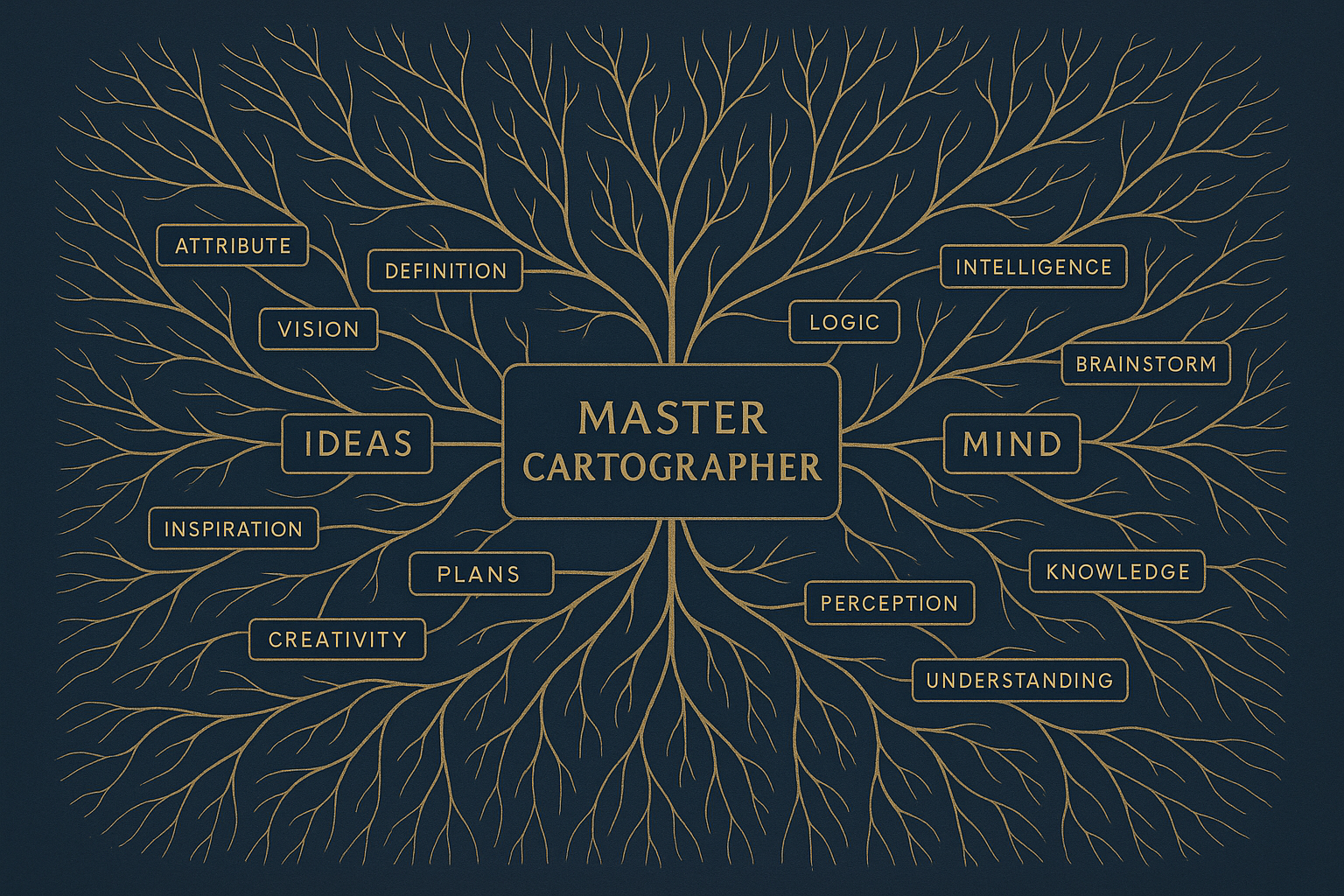
A mind map is a network drawn on paper or a screen. A central idea sits at the core, and branches radiate outward to primary themes, which then extend further into supporting details, evidence, examples, and connections. That structure isn't arbitrary. It mirrors almost exactly how your hippocampus organizes and retrieves information.
The central node of a mind map serves as the retrieval cue. It answers the brain's first question when searching for stored knowledge: what is this about? From there, primary branches create category-level chunks, the three to seven main ideas that form the skeleton of the book. Secondary nodes add specific detail within those chunks. And cross-links, the lines you draw between different branches, mimic the associative paths your brain uses to leap from one idea to another.
By organizing information this way, you create a mental map that doesn't just capture content but recreates the experience of understanding that content. You're not just remembering facts; you're remembering how those facts fit together, how they relate to each other, and why they matter. Imagine reading Sapiens by Yuval Noah Harari and creating a mind map where evolution, agriculture, and capitalism are interconnected in a web of causation and consequence. Such a map not only helps recall but deepens comprehension.
Real-World Applications: From Books to Boardrooms
Mind mapping isn't just for book summaries. Its applications span a wide array of real-world scenarios, each benefiting from the same cognitive advantages.
- Business and Management: In the fast-paced world of business, clarity is key. Mind maps can help you distill complex strategies into clear, actionable plans. By visualizing the connections between various business processes, stakeholders, and outcomes, decision-makers can see the bigger picture and communicate it effectively to their teams. For example, a project manager can map out a product launch by linking timelines, resources, and marketing strategies, ensuring that all team members are aligned and informed.
- Education: Teachers can use mind maps to design curricula that make the structure of a subject visible to every student. Students, on the other hand, can employ mind maps for studying, ensuring they grasp not just isolated facts but the relationships between concepts, which is crucial for deep learning. A history student could map out the causes and effects of World War II, linking political alliances, economic conditions, and key battles to understand the broader narrative.
- Personal Development: Mind maps can serve as visual journals, helping you track personal growth, set goals, and reflect on your journey. By mapping out your aspirations and the steps needed to achieve them, you turn abstract dreams into tangible plans. For instance, someone aiming to improve their fitness might create a mind map linking diet, exercise routines, and mental health practices to achieve a holistic approach to well-being.
These examples showcase the versatility of mind maps as tools for both individual and collective progress. They allow us to visualize and organize our thoughts in a way that reflects our natural cognitive processes, leading to deeper understanding and retention.
Our Take: The Summary Maps Philosophy
At Summary Maps, we believe that the way we organize knowledge is as important as the knowledge itself. Mind maps embody our philosophy of holistic learning, where understanding is prioritized over rote memorization. We advocate for a learning journey where ideas are interconnected, leading to a more profound comprehension of the material.
Our unique angle is to see mind maps not just as tools but as bridges between the known and the unknown. By charting out what we know, we create pathways to explore what we don't. This approach fosters curiosity, encouraging learners to delve deeper and make connections they might have otherwise missed.
We also emphasize the importance of personalization. No two minds are the same, and neither should be their maps. We encourage you to adapt mind mapping techniques to suit your unique way of thinking, thus ensuring that these tools become extensions of your cognitive processes. Whether you prefer colorful, artistic maps or minimalist, structured ones, your mind map should reflect your own preferences.
Conclusion: Actionable Steps to Get Started
Inspired to give mind mapping a try? Here's how you can start today:
- Choose Your Tools: Whether you prefer digital platforms like MindMeister, XMind, or traditional pen and paper, finding the right tools will make the process enjoyable and effective. Digital tools offer the advantage of easy editing and sharing, while paper can encourage creativity and focus.
- Select a Book or Topic: Begin with something you're passionate about. This will keep you engaged and make the mapping process easier. Perhaps start with a book that has impacted you profoundly or a subject you wish to explore in depth.
- Create Your First Map: Start with the central idea and branch out to key themes. Add details, examples, and connections as you go. Remember, there's no right or wrong way—only what works best for you. Allow your mind map to evolve as your understanding deepens.
- Review and Revise: Your mind map is a living document. Revisit it regularly to update and refine as you learn more. This iterative process reinforces memory and understanding, allowing your knowledge to grow over time.
- Share and Discuss: Sharing your mind maps with others can provide new perspectives and insights. Engage in discussions with peers or colleagues to further enrich your understanding and expand your mental map.
With these steps, you're well on your way to transforming how you remember and interact with books—and the world around you. Embrace the associative power of mind maps and watch your knowledge take root in ways it never has before. At Summary Maps, we're excited to see how you harness this tool to unlock your potential and redefine your learning journey.
Get the book
- Sapiens by Yuval Noah Harari: Buy on Bookshop.org
Bookshop.org supports independent bookstores. Summary Maps may earn a commission from book links on this page (as an Amazon Associate we earn from qualifying purchases), at no extra cost to you.
Want to go deeper?
Turn this book into an interactive visual mind map on Summary Maps. Explore every chapter, key idea, and connection — all in one view.
Try Summary Maps Free →