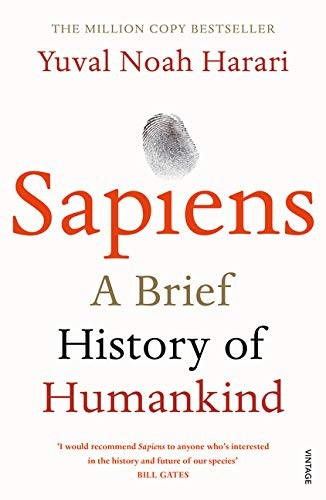
Imagine opening a book that promises to unravel the very fabric of human history, only to find yourself not just reading, but actively engaging with a profound argument about the essence of our species. This is precisely the experience Yuval Noah Harari offers in Sapiens: A Brief History of Humankind. Harari doesn't just recount history; he crafts an audacious narrative that challenges our understanding of what it means to be human. As we delve into this exploration, let's arm ourselves with a mind map—a tool that transforms this journey from a chronological stroll into a logical expedition, unveiling the core argument underpinning human dominance.
The Central Claim: Unraveling the Human Experience
At the heart of Harari's thesis is a seemingly simple yet revolutionary idea: Humans have come to dominate the planet because we possess a unique ability to cooperate flexibly in large numbers, and this is possible because we believe in shared fictions. This statement is not merely an observation; it's a lens through which the entirety of Sapiens unfolds. As we map this argument, it becomes clear that Harari isn't interested in a mere succession of historical events. Instead, he is dissecting the "why" behind our species' unparalleled trajectory. It's a narrative that is simultaneously brilliant, provocative, and, at times, unsettling.
The power of shared beliefs is what sets Homo sapiens apart from every other species. Unlike lions or chimpanzees, humans can be motivated to work together towards abstract goals—ones that exist purely in the realm of ideas. This ability to rally around concepts such as money, religion, and nations forms the crux of Harari's argument. Our task, then, is to map out this central claim, recognizing that it's the engine driving the entirety of human history as presented in Sapiens.
Four Pillars of Human Dominance: A Logical Framework
While Harari organizes Sapiens chronologically, to truly grasp the underpinning logic, we must map out the four intellectual pillars he constructs. These pillars form the backbone of his argument, each representing a pivotal moment in human development.
- The Cognitive Revolution: Approximately 70,000 years ago, a significant shift occurred in the Homo sapiens brain. This revolution enabled us to think and communicate about things that don't physically exist. The ability to share beliefs in gods, nations, and myths laid the groundwork for complex societies. For instance, consider the way religions unify vast numbers of people under a common belief system, allowing for large-scale cooperation and the establishment of cohesive communities.
- The Agricultural Revolution: Around 12,000 years ago, humans began to domesticate plants and animals. This shift from foraging to farming transformed societal structures, but also introduced new challenges and hierarchies. The surplus of food allowed populations to grow, leading to the development of cities and the division of labor, but it also resulted in social stratification and resource-based conflicts.
- The Unification of Humankind: As human societies grew, so did the need for common myths and systems to bind us. Religions, empires, and trade networks emerged, creating a more interconnected world. The Roman Empire, for instance, unified a vast array of cultures under a single political framework, facilitated by shared languages and legal systems.
- The Scientific Revolution: Beginning in the 16th century, the pursuit of knowledge and empirical evidence fueled unprecedented advancements in technology and understanding, propelling humanity into the modern age. This era saw the emergence of the scientific method, which transformed medicine, industry, and daily life, setting the stage for ongoing technological progress.
In mapping these pillars, we uncover the skeleton of Harari's argument, revealing how each stage built upon the last, culminating in our current global society. Each pillar is not just a historical event but a transformation in human capability and perception.
Practical Applications: Mapping Your Own Path
Now that we've dissected the logical framework of Sapiens, let's explore how this understanding can be applied practically. Mind mapping, as a tool, is not confined to summarizing books. Here's how you can implement it in various real-world scenarios:
- Organizational Strategy: Businesses can use mind maps to visualize strategic plans, aligning team efforts towards shared goals. This enhances communication and ensures everyone is on the same page. For example, a tech startup might map out its product development cycle, identifying key milestones and resource allocations, which can help streamline processes and encourage collaborative problem-solving.
- Educational Settings: Students can employ mind maps to break down complex subjects, fostering a deeper understanding of the material. This technique aids in memory retention and critical thinking. For instance, a history student might map out major events and themes of a particular era, connecting them to broader historical narratives and trends.
- Personal Development: Individuals can map out personal goals and life plans, creating a visual representation of their aspirations and the steps needed to achieve them. By laying out a mind map, you gain clarity on priorities, identify potential obstacles, and track your progress over time.
- Creative Projects: Artists and writers can use mind maps to brainstorm ideas, structure their narratives, and explore different creative directions. This visual representation can spark inspiration and lead to more cohesive and compelling work.
By engaging with mind mapping, we not only enhance our comprehension of Harari's arguments but also cultivate a skill that can transform how we process information in everyday life.
Editorial Opinion: The Summary Maps Perspective
Here at Summary Maps, we believe that Sapiens offers more than just a history lesson; it provides a framework for understanding the profound impact of shared beliefs on human society. Harari's argument resonates deeply with our mission to promote visual learning and critical thinking. By mapping the book's central thesis and supporting pillars, readers can engage with the material on a deeper level, uncovering insights that might be missed through linear reading alone.
We find Harari's work particularly relevant in today's world, where the power of shared beliefs is continually shaping global dynamics. The rise of digital currencies, social media platforms, and transnational movements are modern manifestations of the same cognitive abilities Harari describes. These developments challenge us to consider how new fictions and narratives can either unite or divide us on unprecedented scales.
Moreover, Harari's exploration invites us to question the very narratives we take for granted. In a world increasingly driven by abstract concepts—be it digital currencies, virtual communities, or global ideologies—understanding the mechanics of shared beliefs is more crucial than ever. We at Summary Maps are excited to explore these themes further and encourage our readers to do the same.
Conclusion: Taking the Next Step
As we conclude our exploration of Sapiens, we invite you to take actionable steps in your own learning journey. Start by creating a mind map of a topic or concept you're passionate about. Use Harari's method of dissecting arguments into logical components to deepen your understanding and uncover fresh perspectives.
Consider engaging with communities that share your interests and explore how shared beliefs shape collective actions. Whether through online forums, local clubs, or professional networks, these interactions can provide valuable insights into the power of collective imagination and cooperation.
Remember, the power of shared beliefs is not just a historical curiosity—it's a dynamic force shaping our present and future. By mastering the art of mind mapping, you equip yourself with the tools to navigate an increasingly complex world, turning abstract ideas into tangible insights.
Join us at Summary Maps as we continue to explore the intersection of visual learning and intellectual curiosity. Together, let's chart a path towards a more informed and connected future, where the lessons of the past illuminate the possibilities of tomorrow.
Get the book
- Sapiens by Yuval Noah Harari: Buy on Bookshop.org
Bookshop.org supports independent bookstores. Summary Maps may earn a commission from book links on this page (as an Amazon Associate we earn from qualifying purchases), at no extra cost to you.
Want to go deeper?
Turn this book into an interactive visual mind map on Summary Maps. Explore every chapter, key idea, and connection — all in one view.
Try Summary Maps Free →