Last month you read a great summary. It was clear, it was fast, and you closed the tab feeling like you had actually learned something. A week later, someone mentions the book at dinner. You remember the title. You remember one line. You nod and hope nobody asks a follow-up question.
That experience is the real problem, and it is the one most "best AI book summarizer" articles never touch.
What the roundups measure (and what they get right)
Search for the best AI book summarizer and you will find a steady stream of roundups. One example is MindMap AI's October 8 post, "6 Best AI Book Summarizers in 2026." Posts like this are useful, and it is worth saying so plainly. They help you compare tools on the things that are easy to compare: how fast a summary arrives, how long it is, what it costs, and which formats it supports.
Summarizers also do real work. They are good for triage. If you are deciding whether a 400-page book deserves a weekend, a two-minute summary is a sensible filter. They are good for previews, for refreshing something you read years ago, and for getting oriented in a field you are new to.
None of that is wrong. It is just aimed at one question: how quickly can I get through this book?
What no roundup measures
There is a second set of questions that never makes the comparison table:
- Can you retrieve the book's main ideas two weeks from now, without looking?
- Do those ideas connect to anything you already know, or do they sit alone?
- Did you ever use one of them at work, in a decision, or in a conversation?
A summary compresses a book. Compression is not retention. You can finish a summary quickly and still have nothing durable to show for it, because the summary did the organizing for you, and organizing is where much of the learning happens. Handing that step to a tool feels efficient, but it can leave you holding a tidy paragraph in place of a mental model.
If you want to read more about why this happens, we wrote about it in The Forgetting Curve and Your Reading. The short version is that new information fades unless you return to it and use it.
So the useful question is not "which summarizer is best?" It is "what happens to what I read after the summary ends?"
The alternative: a book journal
A book journal is a simple, repeatable loop. It has five steps.
- Read. Read the book, or a good summary of it. Use whichever fits the time you have.
- Map. Turn the book into a visual model on one page: the central argument in the middle, the main ideas as branches, supporting examples as smaller branches.
- Connect. Link what you mapped to something you already know or care about. A work project, another book, a decision you are facing.
- Revisit. Come back to the map on a schedule, and test yourself from the branches before you reread anything.
- Apply. Use one idea in the real world and note what happened.
Nothing in that loop requires you to read slowly. It requires you to leave something behind that you can return to.
One book, all five steps: Atomic Habits
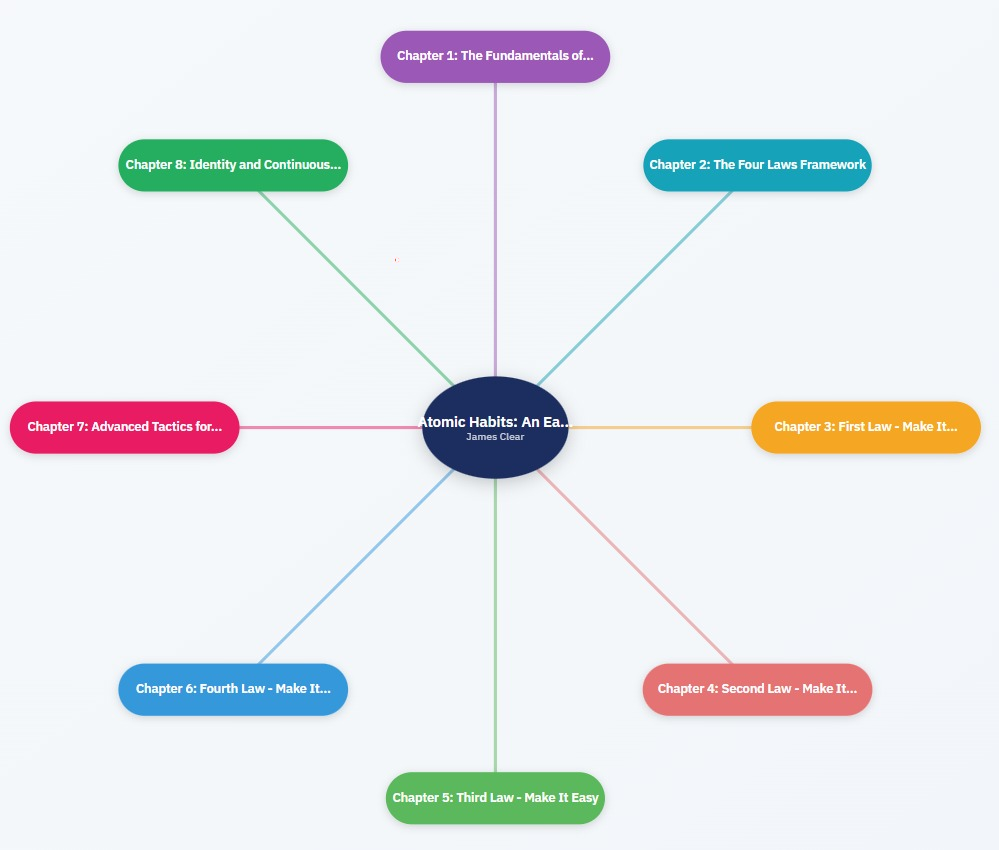
Here is the loop with one real book, James Clear's Atomic Habits. It is a good test case for two reasons. Its structure is clean: a foundation, four laws of behavior change, and some advanced tactics, so the shape of the book fits on one page. And it is the kind of book people finish feeling motivated and then struggle to apply.

Read. The book's central claim is that small behavior changes, repeated, add up to large results over time. Clear organizes the how around four laws: make it obvious, make it attractive, make it easy, make it satisfying.
Map. On the Summary Maps version, the book sits in the center. Around it are branches for the fundamentals, the four-laws framework, one branch for each of the four laws, then advanced tactics and identity. You can see the whole argument at a glance: a foundation, four parallel tools, and what to do once the basics are in place. A reader who has only skimmed a summary often cannot say how the four laws relate to each other. On the map it is obvious that they are four versions of the same job.
You can see the book's page here: Atomic Habits on Summary Maps.
Connect. This is the step a summary cannot do for you, because it depends on your own life. Pick one habit you are trying to build or break and attach it to the matching law. If the habit is working out before work, the "make it easy" branch is the one to extend. Add a line of your own under it, such as "pack the bag the night before."
Revisit. A week later, open the map and cover the branch labels. Can you name the four laws in order? Can you say, for each, what it asks you to do? Whatever you cannot recall tells you where to reread, and it is usually one law, not the whole book.
Apply. Choose one law and use it on one habit for a week. Clear also gives an inverted version of each law for habits you want to stop, so the same map works in both directions. Afterward, note what changed. Now the idea is something you have used, which is different from something you have read.
For more on turning a whole non-fiction book into a single readable structure, see 3 Patterns Every Non-Fiction Book Follows.
Learning from a summary vs. learning from a book map
| A summary | A book map | |
|---|---|---|
| How ideas are stored | As a linear block of text | As a structure: central idea, branches, sub-branches |
| How ideas are linked | Mostly implied by the author's order | Visible, and you can add your own links |
| How you review it | Reread the text | Cover the labels and recall the branches |
| What you notice | What the summary chose to include | What you could not recall, and so where the gaps are |
| What it is best for | Triage, previews, quick refreshers | Retention, connecting ideas, using them later |
| The effort it asks of you | Very little | A little more, and that is where the learning is |
This is not a case against summaries. It is a case for using each tool for what it is good at. Use a summary to decide. Use a map to keep.
A simple revisit ritual you can copy
You do not need a complicated system. Two returns to each map is enough to start.
At 7 days:
- Open the map and hide or cover the branch labels.
- Say or write the central idea from memory.
- Name each main branch, then check yourself against the map.
- Mark any branch you missed. Reread only that part of the book.
At 30 days:
- Do the same recall exercise from scratch.
- Pick one branch and write a sentence about where you used it, or could use it, in your own work.
- Add one new connection to another book or a project you are working on.
The point is the order: try to recall first, then look. For the longer story behind that idea, see our piece on spaced repetition for books.
Reading is not the same as finishing
A summary is a fine way to start. It is a poor place to stop.
Reading is not finishing a book. It is building a mind you can reuse: ideas that connect to each other, connect to your own work, and are still there when you need them. That takes a record you can come back to.
If you want to try the loop, you can build your first map for free: Try Summary Maps.