You know the feeling. Within ten minutes of meeting some people, the conversation just works. With others, you can spend years in the same office and never get past the weather. We tend to call the first experience chemistry, or a good vibe, and we treat it as something that happens to us.
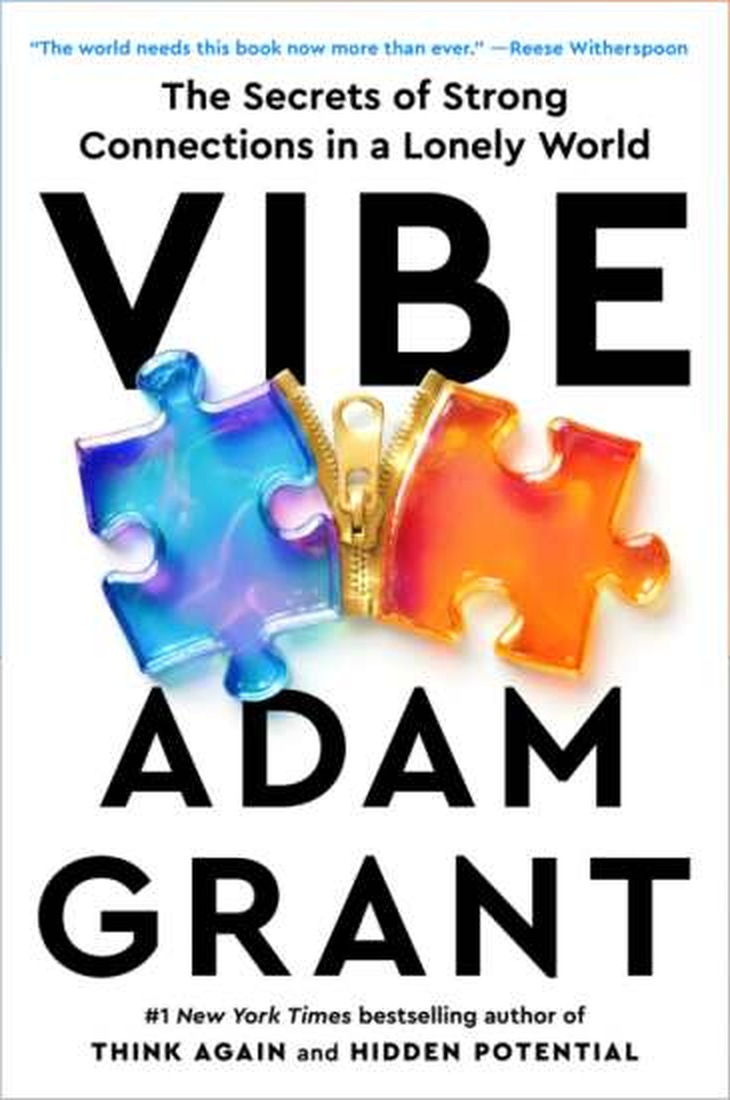
Adam Grant's new book argues that this belief is holding us back. Vibe: The Secrets of Strong Connections in a Lonely World makes a plain, hopeful claim: connection is not just luck. It can be understood, and a great deal of it can be built on purpose.
Drawn from the publisher's description and published coverage of the book.
Why this book, and why now
Vibe landed in October 2026 and has since appeared on the New York Times hardcover nonfiction list. The timing is not an accident. The publisher frames the book around a problem many people feel: face-to-face contact has been displaced by screens, more of our communication is being outsourced to AI, and the world feels more polarized. Loneliness is the result, and building meaningful ties has become one of the pressing problems of the moment.
Grant is an organizational psychologist at the Wharton School and the author of Give and Take, Think Again, and Hidden Potential. Where those books asked how we help, how we rethink, and how we grow, this one asks how we connect. That makes it a natural companion to the rest of his work, and a book with unusually wide reach: it covers friends, partners, coworkers, teams and communities, not just romance.
One more thing sets the tone. Grant has said he is a shy introvert who learned to become what he calls an enthusiastic convener. That personal thread matters because it models the book's central idea. If a shy person can get better at connection, connection is a skill.
The core idea: vibes can be built
The book's central claim is that a vibe is not magic. When we "click," something specific is going on: shared attention, mutual understanding, and a sense that the other person is responding to us. Grant's argument is that these ingredients can be recognized, and that many of them can be created deliberately.
That is a bigger claim than it sounds. If chemistry were fixed, the only move would be to keep searching for compatible people. If chemistry can be built, the move is to get better at the things that produce it. One reviewer noted that Grant frames his own book as an idea book, not a self-help book. He keeps heavy research detail in the endnotes and focuses the main text on concepts, stories and a warm, practical tone.
The four relationship wavelengths
The most memorable framework in the book is a way of sorting relationships by their purpose instead of their label. Rather than "friend," "coworker" or "family," Grant describes four wavelengths:
- Associates are transactional ties. You exchange something specific, such as work, a service or a favor.
- Allies are partnerships built on a shared purpose. You are pulling in the same direction.
- Pals are bonds of amusement. The point of the relationship is enjoyment and play.
- Companions are bonds of care. You offer and expect emotional support.
The framework earns its place because it explains a very common kind of disappointment. Problems often appear when two people are on different wavelengths. One person treats a colleague as a companion while the other sees an associate. Neither is wrong. They just expect different things, and the gap shows up as hurt or resentment.
Naming the wavelength is the fix. When you know what kind of tie you are in, you can adjust your own behavior and your expectations. You can enjoy a pal for the fun they bring without resenting the lack of emotional depth, and you can invest properly in a companion when care is what the relationship needs.
Three myths the book takes apart
The publisher's copy lists three beliefs that Grant sets out to overturn. Each one gives people a reason to give up on a connection too early.
- Similarity is not required for solidarity. We assume we bond with people who are like us. The book points to cases where people built trust with others they did not initially like, such as astronauts learning to rely on crewmates, and a school that moved away from bullying and violence. Shared purpose and working together can do what similarity cannot.
- Chemistry does not always happen quickly. Some of the strongest bonds start slowly. If you write off every low-spark first meeting as a bad vibe, you will miss relationships that need a few more conversations to warm up.
- Closeness does not always take time. The reverse is also true. Under the right conditions, such as shared effort, openness and clear expectations, people can become close faster than we expect. And strong ties do not demand constant contact. A comedy troupe the book describes stays together partly by taking time apart.
A fourth idea runs underneath all three: conflict and distance are not automatically threats. An excerpt published by Oprah Daily looks at how couples can make disagreements more playful and collaborative, and the publisher's description mentions a band that grew closer by learning to argue better. The point is not that fighting is good. It is that how you handle friction decides whether it pulls you apart or draws you in.
What you can try this week
The book is a set of ideas, but the interviews and excerpts point to habits you can test right away:
- Identify the wavelength. Pick three relationships that frustrate you. For each, ask which wavelength you assumed and which one the other person assumed.
- Skip some small talk. Grant often recommends curiosity and richer questions over surface chat. Ask about stories and values, not just updates.
- Ask for advice, not just feedback. In interviews he suggests that asking for advice opens a more useful, more personal conversation.
- Give slow connections a second chance. Think of someone you wrote off early. What would a second, lower-pressure conversation look like?
- Make conflict collaborative. Next disagreement, try framing it as a shared problem to solve together rather than a contest to win.
How to map Vibe
Vibe is an excellent book to turn into a mind map, because its ideas are built from clear categories. Here is a structure that works:
- Center: Vibes can be built.
- Branch 1, the problem: loneliness, screens, AI-mediated communication, polarization.
- Branch 2, the four wavelengths: associates, allies, pals, companions, each with one example from your own life.
- Branch 3, the three myths: similarity, speed, time, each with the story the book uses to challenge it.
- Branch 4, friction and distance: playful conflict, the band, the comedy troupe.
- Branch 5, apply it: your five habits from the section above.
The map does the job a summary cannot. It shows how the four wavelengths relate to each other, and it leaves a branch for your own examples. If you want the method behind that, see our book-journal approach and 3 Patterns Every Non-Fiction Book Follows. For why revisiting a map matters, read The Forgetting Curve and Your Reading.
Key takeaways
- Vibes are not purely luck. Grant argues they can be understood and built.
- Relationships have different purposes. Associates, allies, pals and companions each expect something different.
- Many disappointments are really mismatched expectations, not bad people.
- Similarity, instant chemistry and constant contact are not requirements for a strong bond.
- Conflict and time apart can strengthen a relationship when handled well.
Vibe: The Secrets of Strong Connections in a Lonely World by Adam Grant was published by Viking on October 13, 2026 (336 pages).
Try it yourself: build a free mind map of Vibe at Summary Maps.
Get the book
Vibe by Adam Grant
As an Amazon Associate, Summary Maps earns from qualifying purchases. Book links on this page are affiliate links, at no extra cost to you.